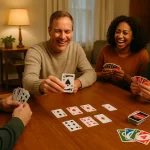
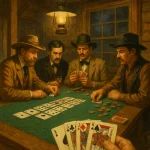
Every game tells a story — not just about play, but about people.
And few card games capture that story quite like Euchre, a game that sailed across oceans, changed languages, and found a permanent home in America’s heartland.
It’s a story that starts in 18th-century Europe, winds through the immigrant experience, and ends around kitchen tables in Ohio and Ontario — a tale of adaptation, humor, and the universal human need to connect through play.
- The European Beginnings – Trick-Taking Before Euchre Had a Name
- Crossing the Atlantic – The Immigrant’s Deck
- Adapting to the New World – Simplicity Meets Spirit
- A Game of Language and Identity
- Why It Flourished in North America
- From Parlors to Print – The Moment Euchre Became American
- The Canadian Connection
- Evolution and Endurance
- Why Origins Still Matter
The European Beginnings – Trick-Taking Before Euchre Had a Name
Long before it reached the New World, Euchre’s ancestors were already making waves in Europe’s taverns and parlors.
The game likely evolved from Écarté, a French two-player game focused on trump and bluffing, and Juckerspiel, a German game where the Jucker (Jack) held special power.
That word — Jucker — is where many historians believe Euchre got its name.
Through pronunciation shifts and regional dialects, Jucker became Euchre, especially among German-speaking immigrants who settled along the Rhine and later in Pennsylvania.
But what made it travel so far wasn’t just the name — it was the spirit.
Écarté brought elegance, Juckerspiel brought cunning, and together they shaped something new: a fast, social game that rewarded both intellect and instinct.
Crossing the Atlantic – The Immigrant’s Deck
The late 18th and early 19th centuries were an era of movement.
German and French immigrants, driven by hope and hardship alike, crossed the Atlantic with whatever they could carry — and among the few luxuries was often a deck of cards.
In an age before television or even accessible books, card games were portable joy.
They bridged languages, filled long nights, and taught cooperation where words sometimes failed.
Euchre thrived on ships, in settlements, and in the boarding houses of early America.
It was a social equalizer — a game that didn’t need wealth, just wit.
And when these immigrants settled across Pennsylvania, New York, and later the Great Lakes, the game traveled with them.
Adapting to the New World – Simplicity Meets Spirit
By the time Euchre reached the American frontier, it had already changed.
The deck was shortened to 32 cards, then to 24, emphasizing speed over length.
Games could be played in half an hour — perfect for the working families of the growing Midwest.
It wasn’t about money or mastery; it was about moments.
Farmers played after supper, soldiers during downtime, neighbors after church.
And though no one wrote a rulebook at first, the rules of the heartland spread faster than any publication.
As the United States expanded westward, Euchre moved with it — carried in wagon trunks, pockets, and memory.
A Game of Language and Identity
Euchre’s evolution mirrors America’s itself: multilingual, adaptable, proudly hybrid.
French flair blended with German precision, English structure, and American humor.
It was the perfect immigrant story — something old made new again.
Interestingly, Euchre also changed English vocabulary itself.
The word bower, now common in American trick-taking games, comes from the German Bauer (meaning “farmer”), referring to the Jack card’s elevated role.
That single linguistic bridge connects centuries of play — from the Rhine Valley to rural Indiana.
Even the idea of “trump” as a dominant suit traces back to European roots, where atout (French for “advantage”) evolved into trump in English speech.
Language, like the game, adapted through play.
Why It Flourished in North America
You could say the timing was perfect.
Euchre arrived just as America was settling into small-town life — before the industrial rush, when community mattered most.
It fit like a glove.
The game’s design reflected the values of its new players: quick, cooperative, clever.
Four people, two teams, a few good laughs.
That rhythm matched the social pace of early American evenings — intimate, routine, and meaningful.
By the mid-1800s, Euchre had spread from the Atlantic coast to the Midwest, becoming the country’s unofficial pastime.
Even soldiers played during the Civil War, calling it a way to “keep the nerves sharp and the mind easy.”
From Parlors to Print – The Moment Euchre Became American
The earliest printed reference to the game in the U.S. appears in Jonathan H. Green’s 1843 book, An Exposure of the Arts and Miseries of Gambling.
Ironically, Green wrote the book to warn against vice — but in doing so, he immortalized Euchre Card game as one of the era’s most popular games.
Not long after, manufacturers began printing decks specifically for Euchre, including the first Joker cards, originally called “Best Bowers.”
Yes — the Joker was born because of Euchre.
It’s a piece of trivia many players don’t know: that grinning wildcard sitting in modern decks owes its existence to a 19th-century social card game that valued wit and surprise.
The Canadian Connection
Just north of the Great Lakes, Canada embraced the game too — especially in Ontario, where communities of German and Irish settlers found in Euchre a comfortable common ground.
It became a staple of family life and still remains one today.
In some rural towns, Euchre nights are as predictable as the changing of seasons.
That cross-border continuity is one of the game’s quiet marvels: an unbroken thread of play linking two nations by shared laughter.
Evolution and Endurance
While games like Bridge and Poker grew into global industries, Euchre stayed humble.
It didn’t fade — it just remained regional, personal, and proud.
And that may be its secret to longevity.
It never had to chase glamour; it never needed casinos or championships.
Its purpose stayed the same: connection.
Over time, new variants like Bid Euchre added layers of strategy and competition, proving that even traditions can evolve without losing their essence.
Each version carried the same DNA — a love for quick wit, friendly rivalry, and partnership.
Why Origins Still Matter
Tracing the origins of a game might sound like trivia, but it reveals something bigger: how people carry culture through play.
Euchre’s journey — from European taverns to American kitchens — is really a story about migration, resilience, and reinvention.
In every hand dealt, there’s history.
In every shuffle, a memory of how strangers became neighbors.
The cards have changed, the tables look different, but the reason we play remains timeless — to share, to connect, and to make life just a little more human.