cardanoir.com – Card games have long been part of social life in India. They appear during festivals, family gatherings, friendly reunions, weekend breaks, and casual evenings at home. For many people, a deck of cards is more than a collection of printed paper. It creates conversation, friendly competition, shared laughter, and memorable moments between generations.
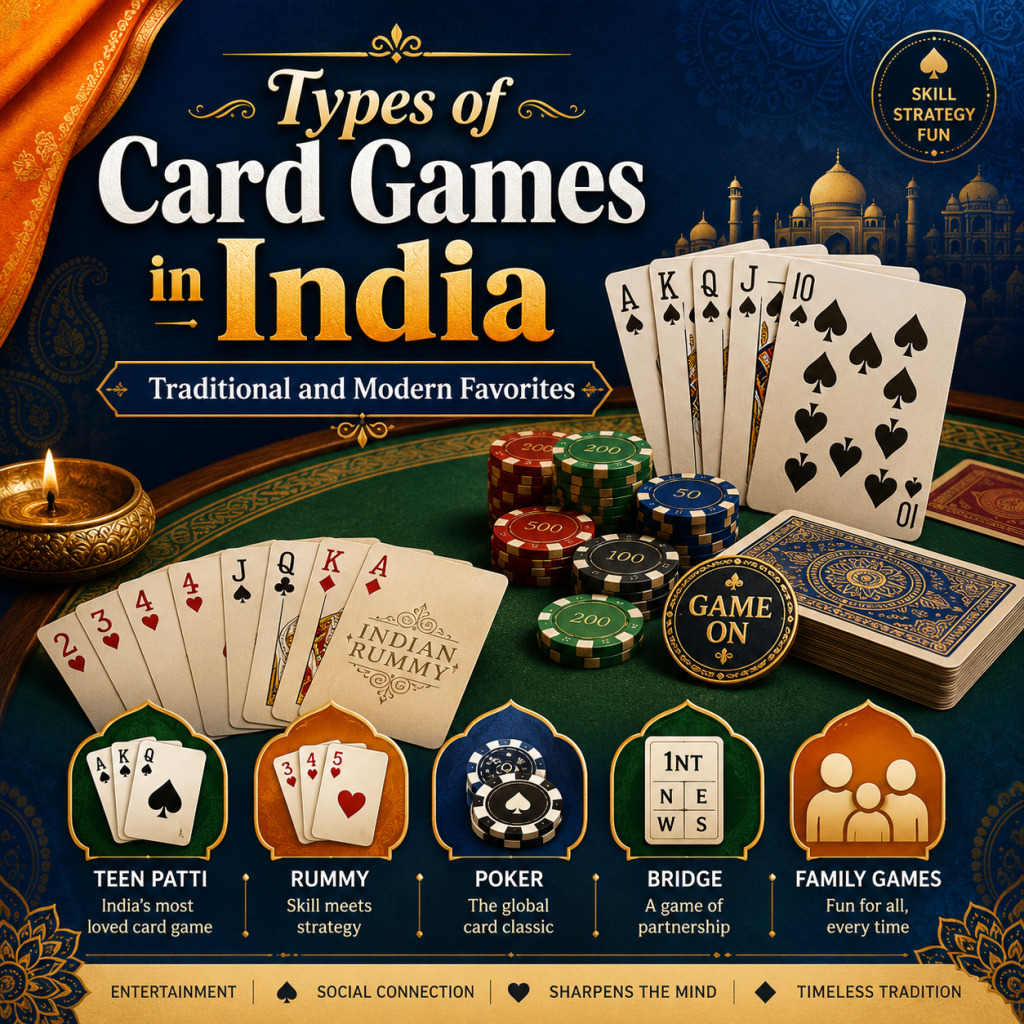
The variety of types of card games in India reflects the country’s diverse traditions and changing entertainment habits. Some games have been passed down through families for decades, while others became popular through clubs, international tournaments, mobile applications, and online communities.
What makes Indian card culture particularly interesting is its flexibility. A single deck can support quick games for children, strategic games for experienced players, partnership-based competitions, and fast-paced party games. The rules may also change slightly from one region or household to another, giving familiar games a distinctive local character.
Why Card Games Remain Popular in India
Card games continue to attract players because they are simple to organize. Most games require only a standard deck, a flat surface, and a few participants. There is no need for expensive equipment or a large playing area.
Their popularity is also connected to three practical qualities:
- Accessibility: A deck of cards is affordable and widely available.
- Variety: The same deck can be used for dozens of games.
- Social interaction: Players communicate, observe one another, and share the experience directly.
Because card games create active participation, they often feel more personal than passive entertainment. One player’s decision immediately affects the next person. As a result, everyone remains involved and the atmosphere becomes lively.
Card games can also encourage memory, concentration, probability awareness, and decision-making. However, the level of skill required depends on the game. Some formats rely heavily on strategy, while others are designed mainly for lighthearted fun.
Traditional Card Games in Indian Culture
Traditional Indian card games are often associated with gatherings and festivals. Rules are commonly taught verbally by relatives or friends rather than learned from official manuals.
Teen Patti
Teen Patti is among the most recognizable card games in India. Its name translates roughly to “three cards,” which describes the basic format. Each participant receives three cards and compares the strength of their hand according to a ranking system.
Common hand rankings include:
- Trail or three of a kind
- Pure sequence
- Sequence
- Color
- Pair
- High card
The game is popular because it moves quickly and creates suspense. Players do not need to manage a large hand, yet they must observe the table and decide how confidently they want to continue.
Why Teen Patti Works Well in Groups
Teen Patti is easy to introduce during a social gathering because rounds are usually short. New players can understand the basic hand rankings after watching only a few turns.
Its social appeal comes from the interaction between players. Facial expressions, confidence, hesitation, and timing can influence how opponents interpret a decision. Consequently, the game feels energetic even when the rules remain simple.
Indian Rummy
Indian Rummy is another widely played game. Unlike Teen Patti, it focuses on arranging cards into valid sequences and sets. A common version uses 13 cards for each participant.
A valid declaration generally requires at least one pure sequence, while the remaining cards must form acceptable sequences or groups. A pure sequence is created without using a joker as a replacement.
For example:
- 4♥, 5♥, 6♥ form a pure sequence.
- 8♣, 8♦, 8♠ form a set.
- 10♠, J♠, Joker may form an impure sequence under suitable rules.
Rummy rewards planning because players must decide which cards to keep and which ones to discard. Because every discarded card may help an opponent, careless decisions can strengthen another player’s hand.
Mendikot
Mendikot is a partnership-based trick-taking game found in several parts of India, especially in western regions. It is commonly played by four participants divided into two teams.
The ten cards usually have special importance, and teams attempt to collect as many of them as possible through tricks. Local variations may use different methods for selecting the trump suit.
Mendikot is appealing because teamwork matters as much as individual skill. Players must understand their partner’s decisions without openly revealing their cards.
Dehla Pakad
Dehla Pakad, sometimes known as “collect the tens,” is another partnership card game. The objective typically involves winning tricks that contain ten-value cards.
The game may appear straightforward, but timing is essential. Playing a powerful card too early may leave a team vulnerable later. Holding it for too long may also cause a missed opportunity.
This balance between patience and action gives the game its strategic character.
International Card Games Commonly Played in India
Indian players also enjoy several games with international origins. These formats have spread through schools, social clubs, tournaments, television, and digital platforms.
Poker
Poker includes several variations, although Texas Hold’em is the most internationally recognized. Players attempt to form the strongest five-card hand or persuade others to withdraw through strategic betting decisions.
Typical poker hand rankings include:
| Ranking | Hand | Example |
|---|---|---|
| 1 | Royal Flush | A, K, Q, J, 10 of one suit |
| 2 | Straight Flush | Five consecutive cards of one suit |
| 3 | Four of a Kind | Four cards of the same rank |
| 4 | Full House | Three of a kind plus one pair |
| 5 | Flush | Five cards of the same suit |
| 6 | Straight | Five cards in consecutive order |
| 7 | Three of a Kind | Three matching cards |
| 8 | Two Pair | Two separate pairs |
| 9 | One Pair | Two cards of the same rank |
| 10 | High Card | Highest unmatched card |
Poker is often misunderstood as a game based only on luck. Random card distribution certainly influences each round, but long-term performance also involves probability, position, observation, and disciplined decision-making.
Bridge
Bridge is a partnership game generally played by four people. It has two broad stages: bidding and card play.
During bidding, players communicate the potential strength and structure of their hands through formal bids. After the contract is established, one partnership attempts to complete the required number of tricks.
Bridge has a steeper learning curve than many casual card games. However, players who enjoy logic, communication, and long-term strategy often find it highly rewarding.
Blackjack
Blackjack is based on reaching a card total as close to 21 as possible without exceeding it. Number cards retain their printed value, face cards count as ten, and an Ace may count as one or eleven.
The rules are easy to understand, which has helped blackjack become familiar worldwide. Players must choose between actions such as taking another card or keeping their current total.
Although decisions can be made quickly, each choice carries a consequence. Taking another card may improve a weak total, but it can also push the hand above 21.
Solitaire
Solitaire is especially useful for individual play. Numerous variations exist, with Klondike being one of the best known.
The player arranges cards according to specific sequences, colors, and suits. Since no opponent is required, solitaire became particularly popular on personal computers and mobile devices.
It offers a calmer experience than group card games and can be enjoyed in short sessions.
Family-Friendly Card Games in India
Not every card game needs complex strategy. Families often prefer games that can be learned quickly by both children and adults.
Bluff
Bluff, also called Cheat in some places, is based on placing cards face down while announcing their supposed rank. Other participants must decide whether the claim is truthful.
If someone challenges the announcement, the cards are revealed. A correct challenge penalizes the player who made the false claim, while an incorrect challenge penalizes the challenger.
The fun comes from reading behavior rather than calculating complicated combinations.
Donkey
Donkey is a casual matching game often played by children and families. Participants usually attempt to form matching groups and avoid being left with the unwanted final card.
The exact rules vary between households, but the game is generally fast and humorous. It works well when the goal is entertainment rather than serious competition.
Memory Card Games
A standard deck can also be used for memory-based activities. Cards are placed face down, and players take turns revealing pairs.
These games are suitable for younger participants because they strengthen visual memory and concentration. They also allow adults and children to play together without a major difference in experience.
Comparing Popular Card Games in India
The best game depends on the number of participants, available time, and preferred level of complexity.
| Card Game | Typical Players | Main Skill | General Pace |
|---|---|---|---|
| Teen Patti | 3–6 or more | Observation and confidence | Fast |
| Indian Rummy | 2–6 | Sequence building and planning | Moderate |
| Mendikot | 4 | Teamwork and trick management | Moderate |
| Dehla Pakad | 4 | Timing and partnership | Moderate |
| Poker | 2–10 | Probability and observation | Variable |
| Bridge | 4 | Communication and strategy | Slow to moderate |
| Blackjack | Several | Total calculation and decisions | Fast |
| Solitaire | 1 | Organization and planning | Relaxed |
| Bluff | 3 or more | Behavioral observation | Fast |
How Regional Variations Shape Indian Card Games
One of the most interesting features of Indian card culture is the presence of household and regional variations. Two groups may play the same game using slightly different rules.
Differences may involve:
- The number of cards distributed
- The use of jokers
- The method for selecting trump
- The order of hand rankings
- The scoring system
- The conditions required to win
These changes are not necessarily mistakes. They reflect the way traditional games evolve through conversation and repeated play.
However, variations can cause confusion when people from different backgrounds meet. Therefore, players should agree on the rules before the first round begins.
How to Choose the Right Card Game
Selecting a suitable game becomes easier when the group answers a few simple questions.
1. How Many People Will Play?
Solitaire works for one person, while Bridge requires exactly four. Teen Patti and Bluff can accommodate larger groups more easily.
2. How Much Time Is Available?
A quick game should have short rounds and minimal setup. Teen Patti, Bluff, and simple matching games fit this situation. Bridge or a full Rummy session may require more time.
3. Do Players Prefer Skill or Casual Fun?
Strategic groups may enjoy Bridge, Poker, Rummy, or Mendikot. Families looking for laughter and easy interaction may prefer Bluff, Donkey, or memory games.
4. Are Beginners Joining?
When new players are present, begin with a game that has visible actions and a limited number of rules. A complicated format can slow down the evening and reduce participation.
A Practical Review of Indian Card Game Experiences
From a practical point of view, Indian Rummy offers one of the best balances between accessibility and strategy. The objective becomes clear after a few rounds, yet the process of arranging sequences remains interesting over repeated sessions.
Teen Patti creates a more energetic atmosphere. It is particularly suitable for a group that enjoys quick decisions and strong social interaction. The game can become lively within minutes because every participant is involved in the same central comparison.
Mendikot provides a different experience. It may not be as immediately familiar to every beginner, but partnership play makes each round feel collaborative. A well-coordinated pair can overcome a weaker starting position through careful timing.
For a quiet individual session, solitaire remains a reliable choice. It lacks the excitement of a crowded table, but its structured nature makes it relaxing.
Overall, there is no single game that suits every occasion. The setting influences the experience: a fast social game may work beautifully at a gathering, while a strategic partnership game may be better for a smaller, focused group.
The Influence of Mobile Platforms on Card Games
Digital platforms have introduced traditional games to new audiences. People can now learn rules, practice against computer-controlled opponents, and join remote matches.
This development has several effects. First, regional games can reach people outside their original communities. Second, beginners can practice privately before joining experienced groups. Third, automated scoring reduces disputes over calculations.
At the same time, physical card games retain an important advantage: direct human interaction. The expressions, conversations, jokes, and small traditions around the table cannot be fully reproduced by a screen.
For that reason, digital and physical formats are likely to continue side by side rather than replacing one another completely.
Frequently Asked Questions
1. What are the most popular types of card games in India?
Teen Patti, Indian Rummy, Poker, Bridge, Mendikot, Dehla Pakad, Bluff, Blackjack, and Solitaire are among the most widely recognized games.
2. Which Indian card game is easiest for beginners?
Teen Patti, Bluff, and simple matching games are generally easy to learn. The best choice depends on the players’ ages and the size of the group.
3. What is the difference between Teen Patti and Indian Rummy?
Teen Patti focuses on comparing three-card hands, while Indian Rummy requires players to arrange larger hands into valid sequences and sets.
4. Are Indian card game rules the same in every region?
No. Many games have regional or household variations involving scoring, trump selection, jokers, and winning conditions.
5. Which card game is best for four players?
Bridge, Mendikot, and Dehla Pakad are excellent options for four players because they are designed around two partnerships.
Conclusion
The wide range of types of card games in India shows how a simple deck can support many different experiences, from the quick suspense of Teen Patti to the careful planning of Indian Rummy and the partnership strategy of Bridge or Mendikot. Traditional rules, regional variations, family customs, and modern digital platforms have all contributed to keeping these games relevant. Whether the goal is friendly competition, mental stimulation, or relaxed social interaction, Indian card culture offers a suitable game for nearly every group and occasion.