The world of Golf-style card games is full of surprises, but 4-Card Golf (often called Open-Face Golf) stands apart for one reason:
it turns a casual family game into a sharp, memory-driven micro-duel where every card matters.
If 6-Card Golf feels relaxed
…and 9-Card Golf feels strategic and puzzle-heavy,
then 4-Card Golf is pure tension in a tiny 2×2 grid.
Short rounds.
Swingy draws.
Big payoffs for perfect columns.
And a rhythm that makes everyone say, “Okay, one more.”
In this guide, we’ll explore what makes 4-Card Golf different, why it’s so wildly addictive, and how you can play it smoothly — whether you’re new to the Golf family or already deep into 6-Card, 9-Card, or Double-Deck Golf.
What Makes 4-Card Golf Unique?
Where other Golf variants lean on gradual improvement and long-form scoring, 4-Card Golf is explosive.
With just four cards, every decision hits harder:
- Smaller grid = higher volatility
A single good swap can swing the entire round. - Open-Face tension
You reveal two cards early, then spend the rest of the game chasing improvement. - Column-based scoring = big zeroes
Match two cards vertically and the column scores zero — the most satisfying mechanic in the entire Golf family. - Knocking becomes a mind game
Knock too early and you lose value; knock too late and someone else blindsides you with a zero-column.
It’s lean, punchy, and loaded with mind-games.
Perfect for quick tables, travel play, or players who like more risk-reward than memory-tracking.
How to Play 4-Card Golf (Open-Face Version)
(Fully accurate to the official rules)
Setup
You only need:
- 1 standard 52-card deck (no Jokers, unless you want optional scoring twists)
- 2+ players
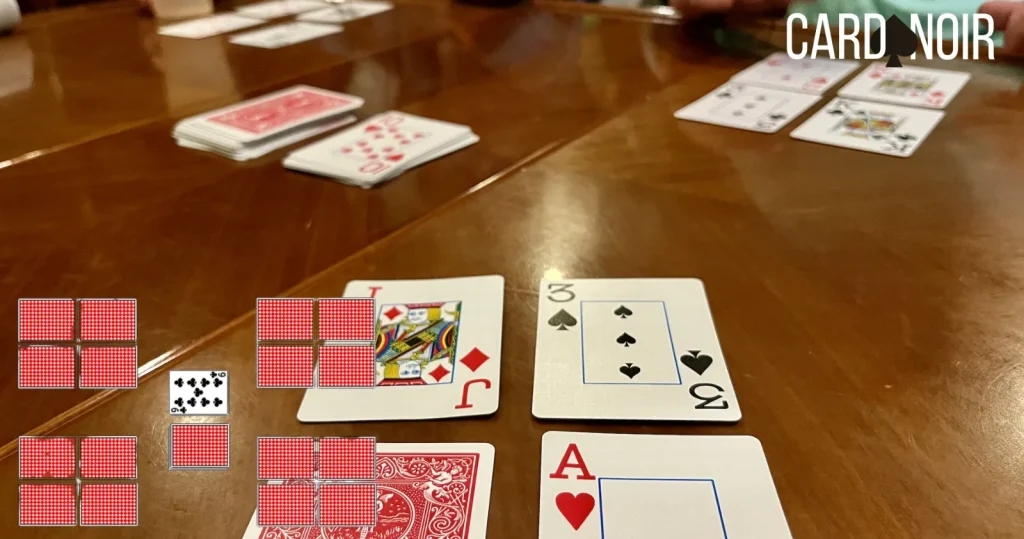
- A 2×2 layout for each player
Deal four cards, all face-down, one at a time.
Players arrange them into a 2×2 square without looking.
Then:
- Place the remaining deck in the center.
- Flip the top card face-up to start the discard pile.
- Players peek at their two bottom cards, memorize them, and return them face-down.
That’s the only information you get before the chaos begins.
Objective
Score the lowest total points across rounds.
Cards score:
- Ace = 1
- 2–10 = face value
- Jack = 10
- Queen = 10
- King = 0
Special rule:
If the two cards in any vertical column are the same rank, that column scores 0.
(This is why players chase perfect pairs — it’s the signature mechanic across all Golf variants.)
Gameplay Flow
Turns proceed clockwise:
On your turn, choose one action:
Draw the top card from the deck
You may:
- Swap it with one of your face-down cards
(discard the old card face-up) - Or discard it immediately
Take the top card of the discard pile
You must replace one of your layout cards.
Knock
Instead of drawing, you may knock — signaling the final round of turns.
After you knock:
- Every other player gets one more full turn
- Then everyone reveals and scores their grid
This creates a delicious timing game:
Knock too early → maybe you miss a zero-column
Knock too late → someone else steals the perfect draw
End of Round & Scoring
Flip all remaining face-down cards, compute column totals:
Example:
- (3 + 9) = 12
- (King + King) = 0
- (Queen + 4) = 14
Small grids create huge swings, which is why 4-Card Golf has the highest “table yelling per minute” ratio in the family.
Play typically continues for 9 rounds, lowest total wins.
Why 4-Card Golf Feels So Good to Play
Golf card games are naturally fun — but 4-Card Golf hits a special sweet spot:
✔ Fast but meaningful
Every card you touch creates a big opportunity or a big risk.
✔ Memory = power
You’ll track which unknown cards are worth flipping because you saw them mid-discard.
✔ Perfect for teaching
It’s easier to learn than 6-Card or 9-Card Golf, but still has depth.
✔ High-drama moments
Few things beat flipping a face-down card to pair a column — swinging your score from 14 to zero instantly.
✔ Works beautifully as a side-variant
If you already enjoy:
- 6-Card Golf (the standard variant)
- 9-Card Golf (deeper, puzzle-driven)
- Double-Deck Golf (chaotic but strategic)
…then 4-Card Golf becomes the perfect fast-play companion that keeps the Golf experience fresh.
Strategy Tips for 4-Card Golf
These apply perfectly across competitive and casual tables:
1. Prioritize vertical pairs early
A zero column is golden — you can build a round around it.
2. Don’t flip too aggressively
Unknown cards can tank your round unless the draw pile is favorable.
3. Use discard signals
Pay attention to:
- What others keep
- What others throw away
- What numbers repeatedly cycle past the table
4. Knock only when a column looks stable
Knocking with two dangerous unknowns is a common beginner mistake.
5. In late game, protect your strong column
You usually end with:
- One “project” column
- One “safe” column
Don’t sabotage the safe one unless the upside is huge.
4-Card Golf in the Golf Card Game Family
When you zoom out and look at the entire Golf card game universe, each variant has its own personality — almost like different game “moods.”
And understanding where 4-Card Golf fits helps players appreciate why this tiny 2×2 grid version feels so sharp and addictive.
4-Card Golf (Open-Face Golf) sits at the fast-paced end of the spectrum.
It’s compact, tactical, and brutally honest — you see your mistakes quickly, and great plays feel even better. If you enjoy games where every card matters and every swap feels like a gamble, this is the variant that hits the sweet spot.
Meanwhile:
- 6-Card Golf is the “classic” version most people learn first — relaxed, friendly, and easy to teach. It still has strategy, but the vibe is softer, more laid-back, and perfect for families or casual card nights.
- 9-Card Golf widens the grid and deepens the thought process.
With a 3×3 layout, the game starts to feel closer to a puzzle board.
Players have more pieces to manage, more columns to optimize, and more opportunities to engineer those beautiful zero-scoring matches. - Double-Deck Golf is what happens when you throw gasoline on the fire.
It’s chaotic, louder, swingier, and fantastic for larger groups.
Rounds explode with wild cards, surprise flips, and unpredictable scoring swings. If your table likes noise and drama, this is the one.
Against all of that, 4-Card Golf becomes the “clean cut.”
Simple on the table, surprisingly psychological in practice.
It’s the version made for players who love:
- fast rounds
- bold swaps
- subtle memory plays
- timing your knock just right
- and watching a risky flip turn a losing round into a perfect zero column
If the bigger variants give you space to build your round slowly,
4-Card Golf gives you pressure from the very first draw — and that pressure is what makes it so fun.