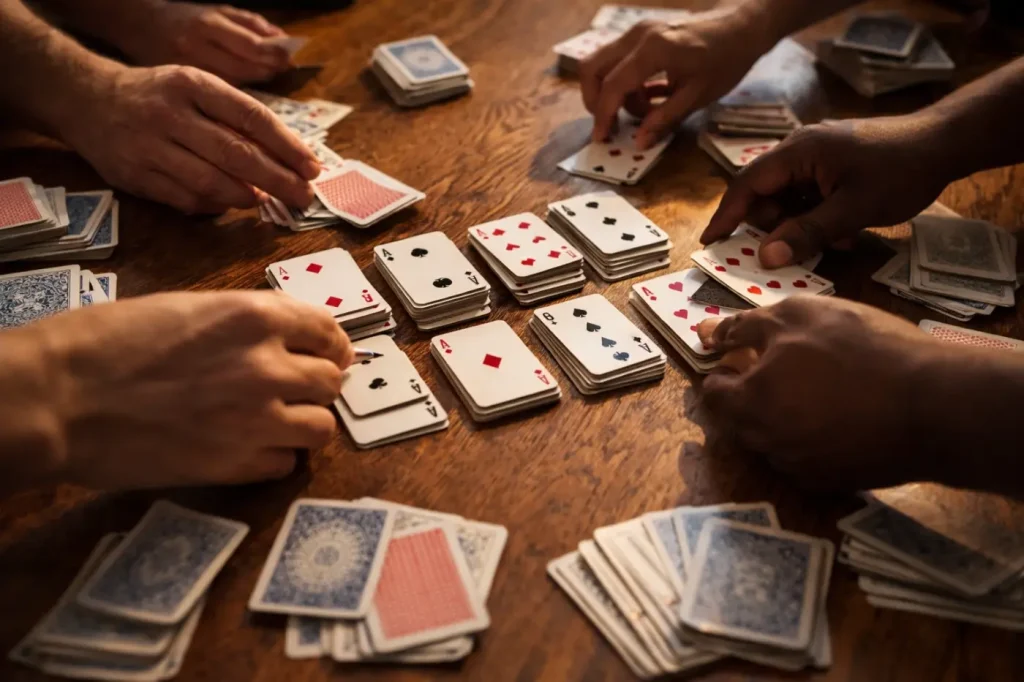
If you’ve ever wished Solitaire had the heart rate of a sprint, Nerts (often searched as the nertz card game or nerts card game) is the answer. It’s a fast-paced, multiplayer “patience” game where everyone plays at once—no turns, no waiting, no mercy. Your hands move like you’re playing Speed, your brain tracks like you’re playing Solitaire, and the table feels like a friendly traffic jam of cards.
In this Cardanoir guide, you’ll get the real nertz rules, a clean breakdown of how to play Nertz, and why this chaotic little race has survived for more than a century under different names, in different countries, and now in digital form too.
What Is Nerts?
Nerts is a multiplayer card game where each player (or team) uses their own full 52-card deck. Everyone plays simultaneously, trying to get rid of the cards in their Nerts pile (also called the Demon in some traditions) by building card sequences—especially in a shared central area where opponents can help or block you without meaning to.
It’s often described as a competitive form of Solitaire, but that comparison undersells it. Solitaire is quiet. Nerts is a small storm.
Best with: 2–8 players (ideally), ages 8+, and people who don’t mind laughing at mistakes made at speed.
Nerts, Nertz, Racing Demon, Pounce: Same Game, Different Names
If search results feel inconsistent, you’re not imagining it. The game travels under multiple names:
- Racing Demon (UK)
- Nerts or Nertz (US usage varies)
- Pounce (a common American name historically)
- Other recorded names include Peanuts, Racing Canfield, Scramble, Squeal, Scrooge, and more.
Origins
Card game historian David Parlett describes it as English in origin, created in the 1890s, and known as Racing Demon. It’s recorded under that name in the early 20th century, with American publications using Pounce from the 1930s onward.
A fun linguistic footnote: a German description appeared in 1927 as Rasender Teufel—literally “Racing Demon.”
What You Need to Play Nerts
You don’t need a special box—just the right setup.
Components
- One standard 52-card deck per player (or per team)
- Each deck should have a different back design or color, so you can sort cards back to owners after the round.
- Table space. More players = more chaos = more space.
Players
There’s no hard cap except decks and space, but most groups find the sweet spot at 2–8.
The Core Idea: What You’re Actually Trying to Do
In Nerts, you’re racing toward two goals at once:
- Dump your Nerts pile (a 13-card pile you must clear from the top down).
- Score by playing cards into the central “Lake”—the communal build piles everyone uses.
The tension is delicious: sometimes the move that helps you score is not the move that helps you empty your pile fastest.
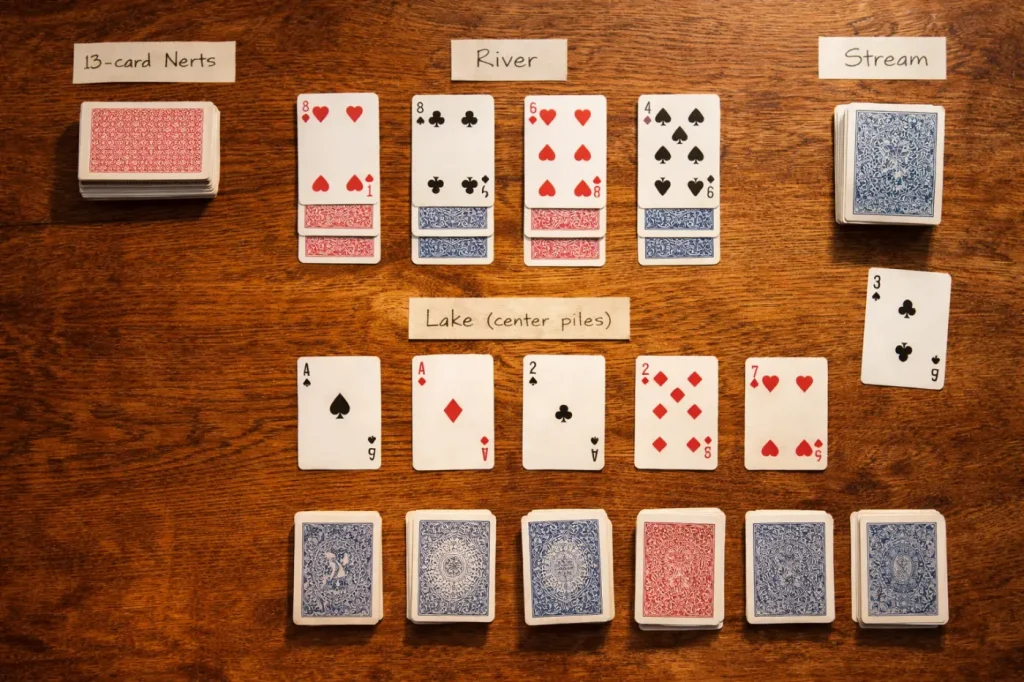
How to Play Nertz: The Table Layout (Lake, River, Stream, Nerts Pile)
Many modern explanations use a geography metaphor. Here’s the clean version:
The Lake (Shared Center)
The Lake is the central area where anyone can build suited piles in ascending order (Ace up, no duplicates within a pile). This is where points usually come from.
The River (Your Tableau)
Your River is your personal area of four columns, built like Solitaire tableau: descending order with alternating colors. You can move cards between columns when legal.
The Stream (Your Stock / Draw)
Your Stream is a face-down pile you flip through (often in groups of three) to find playable cards for your River or the Lake.
The Nerts Pile (Your “Demon”)
This is the pressure cooker: 13 cards face-up (top card visible), and you can only play from the top of it. The first player/team to empty this pile shouts “Nerts!” and the hand ends immediately.
Setup: Step-by-Step Nertz Rules
A standard setup looks like this:
- Shuffle your deck.
- Place 13 cards as your Nerts pile (top card face-up).
- Deal four cards face-up into four columns for your River.
- The remaining cards form your Stream (your draw pile).
Now everyone starts at once.
Gameplay: What Happens During a Hand
There are no turns. Everyone plays simultaneously.
On your “non-turn,” you do a loop:
- Play any legal cards from your River, Stream, or the top of your Nerts pile.
- Build your River down in alternating colors.
- Build the Lake up in suit from Aces.
- Flip your Stream to reveal new options.
- Keep going until someone empties their Nerts pile and calls “Nerts!” Nerts
What can you play where?
- To the Lake: suited ascending sequences starting at Ace (shared scoring area).
- To the River: descending, alternating-color stacks (your personal organization engine).
- From the Nerts pile: only the top card, but it can go to Lake or River if legal.
The moment the round ends
When a player/team empties their Nerts pile, they call “Nerts!” and all play stops.
Then comes the satisfying cleanup: sort the Lake cards back to deck owners using the different card backs.
Scoring: How Points Typically Work
Scoring varies by house rules, but one commonly described approach is:
- Points are based on cards you played into the Lake
- Minus a penalty for cards left in your Nerts pile (often twice the number remaining)
- Some groups add a 10-point bonus for the person/team who called Nerts Nerts
Games often continue across multiple hands until someone reaches a target score like 100—or until the score gap hits a threshold your group sets. Nerts
“How Do You Play Nerts” in Real Life? The Rhythm That Makes It Fun
The rules are the skeleton. The feel is the muscle.
Nerts plays like this:
- Your eyes scan three zones (River, Stream, Nerts pile) like a cashier scanning items.
- Your hands move faster than your ability to narrate what you’re doing.
- The Lake becomes a communal engine that everyone feeds—sometimes you benefit, sometimes you accidentally set up an opponent.
And because everyone plays at once, the game rewards:
- quick reaction
- awareness of what’s changing in the center
- counting and pattern recognition Nerts
It’s a card game that quietly trains your brain while loudly testing your coordination.
Strategy: How to Win Nerts Without Panicking
Winning Nerts is less about “best move” and more about “best flow.”
1) Protect your River as a tool, not a museum
Your River exists to unlock plays, not to look tidy. Break columns open to reveal new cards. A messy River that moves is better than a perfect River that’s stuck.
2) The Nerts pile is your real timer
Every second you spend optimizing the River is time you’re not shaving off your Nerts pile. If the top card can move—even to your River—do it.
3) Learn to “read” the Lake
If the Lake already has multiple Aces started, the game accelerates. If the Lake is barren, focus on creating Aces fast. The Lake’s pace is everyone’s pace.
4) Don’t over-flip the Stream
Many players flip compulsively. Better habit: flip only when you’ve exhausted obvious plays. Stream flips can distract you from a Nerts card that was playable two seconds ago.
5) If you play in teams, assign roles
Teams can coordinate lightly: one person focuses Lake building, the other focuses clearing Nerts. Team Nerts becomes a relay race.
Variations and House Rules (Why Every Group Plays “Their” Nerts)
Nerts survives because it tolerates customization.
Common tweaks include:
- Stream flip style: one card vs three cards
- Bonus points for calling Nerts (often +10) Nerts
- Ending condition: first to 100, best of X hands, or “highest after 30 minutes”
- Negative scoring allowed (some groups keep it brutal) Nerts
If you’re writing this for a rules page, it’s smart to present a “standard baseline” plus a short section of popular options—because readers will compare your version to theirs.
Related Games: If You Like Nerts, You’ll Recognize These
Nerts is closely related to games like:
- Spit
- Dutch Blitz
- Demon / Canfield
- Speed
And several commercial “Nerts-inspired” retail titles share similar DNA, with rule tweaks and branded components.
This family resemblance matters: Nerts didn’t appear in a vacuum. It’s part of a long tradition of making solitaire mechanics social and competitive.
Nerts Online and Digital Versions
Nerts has made the jump to screens without losing its core identity: speed + simultaneous play.
Notable points recorded in reference summaries include:
- An early electronic version released in 1995 for the Atari ST. Nerts
- NERTS! Online released on Steam in January 2021 by Zachtronics, based on an internal version developed the year before.
Digital versions are great for learning because the interface enforces legal moves and removes sorting time between hands. But in-person Nerts has a special magic: the table noise, the shouted “Nerts!”, the shared disbelief when someone empties their pile “already.”
Cultural Footprint: Why Nerts Works Everywhere
Nerts is portable social chemistry. In Jakarta cafés, dorm rooms, family living rooms, and anywhere a table exists, it works because:
- It scales by adding decks
- It doesn’t require long explanations
- It creates instant drama without needing “big” stakes
And it’s a rare competitive game where losing can still feel fun—because everyone’s hands were moving the whole time.
5 Quick, Surprising Facts About Nerts
- The game dates back to England in the 1890s, where it’s known as Racing Demon.
- In the US, it was called Pounce in publications from 1934 onward.
- It’s been documented in German as Rasender Teufel (“Racing Demon”) as early as 1927.
- Player count is limited mostly by space and number of decks, not a strict rule cap.
- A modern digital revival exists on Steam as NERTS! Online (2021).
Nerts as a Human Skill Game
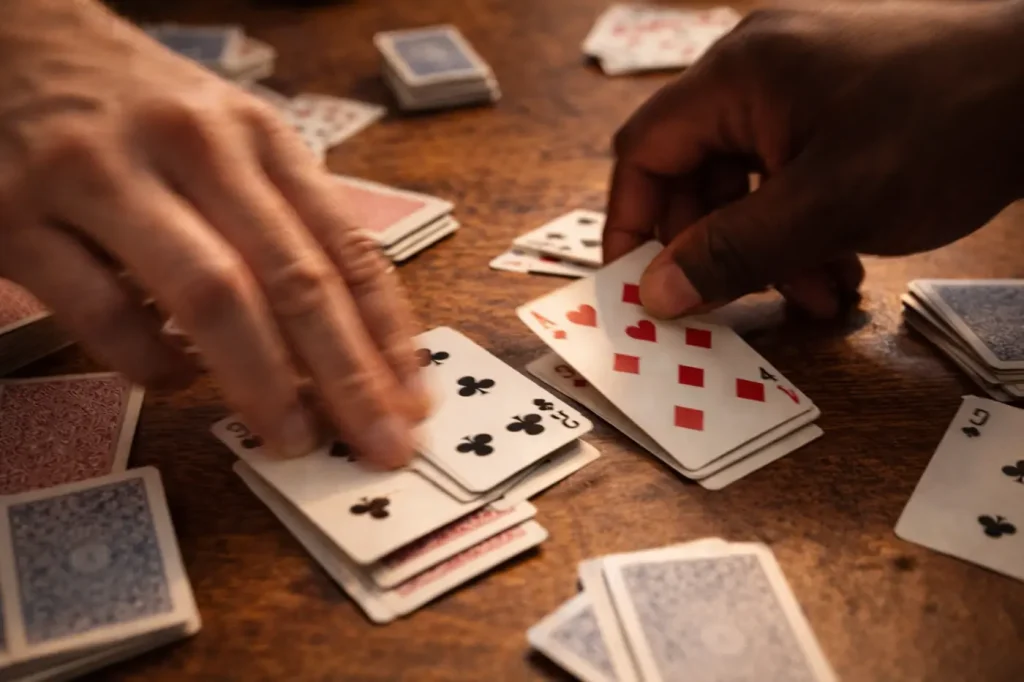
Nerts looks like chaos, but it’s really a mirror. It reveals who thrives under pressure, who stays playful when things go wrong, and who can adapt when the table changes faster than a plan can keep up.
It’s a card game about momentum—how you build it, how you lose it, and how you recover without freezing. In that way, Nerts is less like a puzzle and more like a tiny lesson in motion: keep moving, keep reading the room, and when your chance appears—take it.