
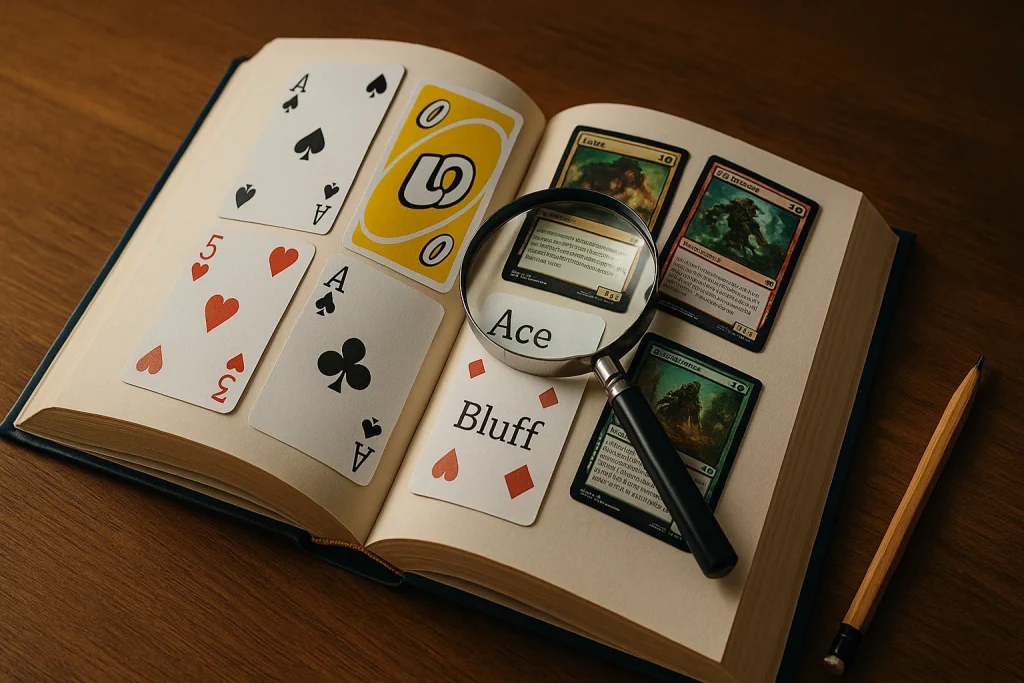
Card Game Glossary Updated – A to Z
Welcome to the Cardanoir Card Game Glossary, a complete A–Z reference for card game terminology. From timeless classics like Poker and Bridge to modern collectible games like Magic: The Gathering and Yu-Gi-Oh!, this glossary helps players of all levels understand the language of card games.Card Game Glossary is a practical reference that explains essential card game terms, playing card terms, and common card terminology used across classic and modern card games. Whether you’re learning the basics or clarifying advanced concepts, this glossary of card game terms covers how cards, hands, decks, and actions are described in real gameplay.
Inside this guide, you’ll find clear definitions of card terms and phrases used in popular games—from general card games vocabulary to specific card game terms poker players use at the table. It also helps decode deck of cards terminology, understand common card game words, and recognize patterns in card games that start with each letter from A to Z.
This glossary is designed for players, writers, and enthusiasts who want a reliable source for card game terms and phrases, including traditional language, modern slang, and widely accepted names for card games. Simple, accurate, and continuously updated—this is your go-to guide for understanding how card games are actually talked about and played.
A
Ace (A) — A flexible card that can play “high” or “low” depending on the game. In Poker it can top a straight or start the low straight (A-2-3-4-5). In Blackjack it counts as 1 or 11 to avoid busting.
Action — Any move you make on your turn: draw, play, discard, declare, or pass. In many modern card games (especially TCG/CCG), “actions” also include activating abilities or playing effects.
Aggro — A fast, pressure-heavy playstyle (common in TCG/CCG) that tries to win early by dealing steady damage and trading efficiency for speed.
Ante — A forced contribution paid before cards are dealt to create an initial pot/pool. It keeps the hand meaningful even before the first play.
B
Balanced hand — A hand with no voids, no singletons, and no very long suit (a “smooth” distribution).
Banker — The person who runs a banking game: takes the stakes, pays winners, tracks the pool.
Banking game — A game where players bet against a banker/house rather than against each other.
Base value — A fixed starting value used to calculate a contract’s final score (often before multipliers).
Batch — Another word for a packet: a portion of the deck.
Batons — A suit in Latin-suited decks (along with Swords, Cups, Coins).
Beater — In some trick-taking families (e.g., Karnöffel-style), a special high-power card that “beats” lower ranks.
Belle — The last game of a rubber (the deciding game in a set).
Bells — A suit in German-suited decks (with Acorns, Leaves, Hearts).
Best — The highest-ranking card (or highest option) available in context.
Best card — The current top remaining card of a suit still in play (also called master/commanding card).
Bet — A wager; also the act of placing chips/stakes during a betting round.
Bête (bete) — A penalty/forfeit for failing a requirement, or a term for a failed contract in some games.
Bettel / Bettler — A bid/contract to win no tricks (often similar to misère).
Bid — An offer/claim about what you’ll achieve (tricks/points) or the right to choose trump/contract.
Bidder — Any player who bids; sometimes specifically the highest bidder (the contractor/declarer).
Blank — (1) A zero-point card in point games; (2) a hand with no court cards; (3) a high card left unprotected (“blank king”).
Blank suit — A suit you hold none of (a void suit).
Blaze — A hand made entirely of court cards.
Blind — A face-down extra hand or extra cards set aside (e.g., widow/skat in some games).
Blocking — Holding back a high card to stop an opponent’s long suit from running tricks.
Bluff — Playing or betting in a way meant to mislead opponents about your real strength or plan.
Build — Adding to table cards to extend a set/sequence (common in adding/melding games).
Bonus — Extra score awarded for special achievements or combinations.
Bower — In Euchre-style games: the key jacks in trumps (right bower = trump jack; left bower = same-color jack).
Bring in a suit — Establishing a side suit so it can win tricks once opponents’ trumps are gone.
Bury a card — Hiding a card deeper in the deck/discard so it’s harder to locate or track.
Buy — Drawing/picking up cards (often from stock/talon) sometimes in exchange for a stake or a discard, depending on the game.
C
Card Advantage — A strategy edge (common in CCG/TCG) where you gain more usable cards/resources than your opponent.
Collectible Card Game (CCG) — Games where players build decks from collectible cards (e.g., MTG, Pokémon).
Combo — A set of cards/abilities that work together to create a stronger effect than each part alone.
Community Cards — Shared face-up cards everyone can use to make a hand (e.g., the board in Texas Hold’em).
Cut — Splitting the deck after shuffling, usually before dealing.
Call — Matching a bet, or announcing a play/decision (depends on the game).
Capture — Taking cards by winning a trick or collecting them from the table.
Chicane — A hand with no trumps.
Chip — A token used for betting or scoring; also the act of putting chips in.
Claim — Stating you can win the remaining tricks to speed up play.
Close — Locking the stock/talon so no more drawing is allowed.
Contract — The agreed challenge for the hand (tricks/points/game type) based on bidding.
Court card — Face/picture cards (King, Queen, Jack, or equivalents).
Cover — Playing a higher card to beat the current winning card in a trick.
Cross-ruff — Partners trumping alternately in different suits to win extra tricks.
D
Dead card — A card that can’t effectively be used in play (context-dependent).
Deadwood — Unmatched leftover cards in your hand (common in Rummy scoring).
Deal — The act of distributing cards; also one full hand from dealing to the next redeal.
Dealer — The player responsible for dealing in the current hand.
Deck — The full pack of cards; sometimes also used to mean the stock/talon.
Declaration — Announcing melds/scoring combos, or naming the contract/game (depends on the rules).
Declare — To bid/announce trump or contract; also used for showing melds in some games.
Declarer — The player who wins the bidding and tries to make the contract.
Declaring side / team — The declarer (and partner, if any) versus the opponents.
Defenders — Players opposing the declarer in contract-style games.
Denomination — The rank/face of a card (2, 3, 4 … K, A).
Deuce — The Two of any suit (often written “2”).
Diamonds — One of the four French suits (♦).
Discard — To get rid of a card (often when you can’t follow suit or as part of turn play).
Discard pile — The pile where discarded cards go (also called wastepile).
Double — Increasing the value of a bid/contract by a factor of 2.
Redouble — Doubling again after a double (effectively x4 of the original).
Double-ended — A card design readable both ways up (indices on both ends; reversible courts).
Doubleton — Holding exactly two cards in the same suit.
Downcard — A face-down card.
Draw — Taking a card from the stock/talon.
Draw lots — Choosing dealer/teams/order by cutting or picking cards at random.
Draw pile — The stock/talon specifically used for drawing during play.
Dress — Setting up the initial layout/stakes before play in some games.
Drop / Drop out — Withdrawing from the current hand (also called fold in many games).
Dummy / dummy hand — An extra hand dealt (often face-down) used by rule, or an “imaginary” player hand.
Durch / Durchmarsch — Winning every trick (same idea as a slam/march).
E
Elder — In many clockwise games, the player seated to the dealer’s left; often has positional priority.
Eldest hand — The first player to act (bid/lead) after the deal; also called forehand in many European games.
Empty card — A card with no special point value (often a pip card), especially in Tarock/Tarot families.
Endhand — Another name for rearhand; typically the last player to act/play in the round.
Entrump — To make a suit into trumps (i.e., designate the trump suit).
Establish — To force out higher enemy cards so your remaining cards in that suit become winners.
Established suit — A suit that will win tricks whenever led because opponents can’t stop it anymore.
Exit — To give up the lead by forcing someone else to win the trick (useful to hand control away).
F
Face card — A picture card (King/Queen/Jack, or equivalents).
Fan (to fan the cards) — Spreading cards in your hand so ranks/suits are easier to read.
Fast game — A quick-playing game with short hands and simple turns (often used for “filler” rounds).
Feint — A deceptive play meant to suggest you hold something you don’t.
Field — All opponents as a group (especially in betting or partnership games).
Finesse — A tactical play where you lead or play a lower honor hoping a higher opposing card is trapped or misplaced.
First hand — The first player to act/lead (often the player left of the dealer).
First trick — The opening trick of a hand; often important for information-gathering.
Fishing — Drawing/playing to “hit” a needed card (commonly used in Rummy/TCG talk).
Fixed trump — A game where the trump suit is pre-set by rules, not chosen by bidding.
Flat hand — A hand with no obvious strength (few honors, weak distribution).
Flush — Poker hand: five cards of the same suit (not in sequence).
Fold — To quit the hand (stop competing) rather than continue betting/playing.
Follow suit — Playing a card of the led suit when you have one (usually mandatory in trick-taking games).
Force — A play that leaves an opponent with only one reasonable response (e.g., making them trump or cover).
Forehand — Eldest hand; the player who acts first after the deal (often left of dealer).
Fourchette — Holding two honors that “surround” a missing honor (e.g., A and Q, missing K) in trick play.
Free card — A card you can play without risk because the suit is safe, or because you’re void and can discard.
Freeze — A rule/state where certain actions (drawing, exchanging, melding) are temporarily blocked.
Frog — A nickname in some games for a special low card role (term varies by region).
G
Game — Can mean the whole pastime, a single variant (rule set), or one finished unit of play that produces a winner (context decides).
Game points — The score awarded for the outcome of a hand/contract (including bonuses). Not the same as card points.
Game value — How much a contract/hand is “worth” once multipliers and bonuses are applied.
German-suited pack — A deck using Acorns, Leaves, Hearts, Bells instead of Clubs/Spades/Hearts/Diamonds.
Good — A concession in bidding: you accept the current bid and won’t challenge it further.
Go out — To finish the deal because you’ve shed all cards (shedding games) or reached the needed tricks/points (trick/point games).
Go over — Either to bid higher (overcall) or to play higher to the trick (term depends on the game).
Guard — One or more supporting cards that protect a high card (e.g., a guarded king).
Gapped run — A near-sequence with a “hole” (e.g., 7–8–10). Often useful for building, but needs the missing rank to become a full run.
Gambit — A deliberate short-term sacrifice (a trick, a card, tempo) to gain a bigger advantage later.
H
Hand — (1) The cards you hold; (2) a single round of play from deal to scoring.
Hand value — The strength/score potential of a hand (points, winners, or synergy depending on the game).
Handicap — A rule or scoring adjustment that makes play more even between players of different skill.
Hard hand — In Blackjack, a hand with no Ace counted as 11 (or an Ace that must count as 1).
Hearts — One of the four French suits (♥).
High card — A strong single card not part of a made combination; also “high-card strength” in many games.
High/Low — Rule where the highest or lowest card wins (or scores), depending on the variant.
Hold-up — Delaying a winning play on purpose to control timing and cut off an opponent’s suit.
Honor / Honour — High-ranking cards (often A-K-Q-J or the top trumps), sometimes worth bonus points.
Hook — A penalty or special rule trigger in some games (meaning varies by title).
House rules — Local adjustments a group plays with (always worth confirming before a session).
Huddle — A quick private talk/plan between partners (in partnership games, if allowed).
I
Index — The number/letter printed in a card’s corner so you can read it while fanning your hand.
In turn — You’re the next player expected to act under the rules (so your move “counts” and can’t be taken back casually).
Invite — Leading a small card from a long suit to encourage a specific response (often to help partner place key cards).
Initiative — Who acts first / controls tempo this round (often equals “on lead,” but some games track it separately).
Interrupt — A permitted play made outside your normal turn order (common in modern card games with reactions).
Instant — A card/effect you can play at flexible timing (e.g., during an opponent’s turn) if rules allow.
In-play — Cards currently active on the table (not in hand, not in discard); what’s “live” for effects and scoring.
J
Jack — A court card (ranked between 10 and Queen in French-suited decks). Often becomes special in games like Euchre (bowers).
Joker — Extra card(s) outside the standard 52-card deck. Usually acts as a wild or special-purpose card (rules define limits).
Joint / Joints — Slang for cards that are linked or work together (region/game-specific).
Jolly — Another term for Joker in some countries and rulebooks.
Jeton — A scoring counter/token used instead of writing points (common in classic European games).
Jettison — Discarding a card to get rid of a loser or to protect your winners.
Jinx — Informal term for a card/play believed to bring bad luck (table talk, not rules).
Jumble shuffle — A messy riffle/overhand mix used casually; not as thorough as a full shuffle routine.
K
King (K) — A court card, usually ranked above Queen and below Ace (varies by game).
Kicker — A side card that breaks ties when main hands match (common in Poker, e.g., same pair but higher kicker wins).
Kitty — A pool of chips/points set aside from antes or fees, often used for bonuses or future deals.
Knock — Signaling you’re ready to end the hand or that you’re “in range” (common in Rummy/Gin variants; exact meaning varies).
Knock card — A card or rule trigger that allows/forces knocking in certain variants.
K.O. (Knockout) — A format where losing a game/round eliminates you from the session or bracket.
Karnöffel — A historic trick-taking game family where certain cards have unusual powers (often referenced in older rule collections).
Kyoodai / Koi-Koi context — In Hanafuda circles, “Koi-Koi” is the push-your-luck call to continue scoring instead of stopping (not a K-word, but often listed near K terms in mixed glossaries).
L
Lay down — To place cards from your hand onto the table (often when melding, declaring, or finishing a turn).
Lay off — Adding cards to someone’s melds to reduce your own deadwood (common in Rummy-family games).
Lead — The first card played to start a trick (and it sets the suit that others must follow if possible).
Lead suit — The suit of the card that was led; usually the suit everyone must follow.
Leader — The player who leads the next trick (typically the winner of the previous trick).
Left bower — In Euchre: the jack of the same color as trump, treated as a trump card (just below the right bower).
Loner / Lone hand — Choosing to play a hand without your partner for a higher reward (Euchre-style rules).
Long suit — A suit where you hold many cards; useful for “running” tricks once higher cards are gone.
Loose card — A card with little support/protection; often easy for opponents to beat or capture.
Lowball — Poker family where the lowest hand wins (rules vary: A can be low; straights/flushes may count or not).
Lucky card — Table slang for a card people feel is helpful; not a rules term, but you’ll hear it in casual play.
Lurk — In some modern card-game communities: holding reactive cards and waiting for the best timing to use them.
M
Machine shuffle — A mechanical shuffle (casino-style) meant for speed and consistency.
Main deck — Your primary draw pile (often used in deck-building/TCG talk to separate it from extra decks).
Make (a contract) — Successfully meeting the bid/goal for the hand.
Mana — Resource used to play cards/abilities in many TCGs (name varies by game).
March — Winning all tricks (or nearly all) for a bonus in some trick-taking games.
Master card — The highest remaining card in a suit that can’t be beaten if played at the right time.
Matchpoints — Scoring method where you compare your result against other tables/players (common in Bridge).
Matrix / Mat — The table layout where cards are placed in a grid or pattern (layout-driven games).
Meld — A declared set or run laid down for points (classic in Rummy families).
Meld value — The points a meld is worth (often different from the cards’ normal values).
Misdeal — A deal that violates the rules (wrong number of cards, exposed cards, etc.) and must be redealt.
Misère — A contract/bid to take no tricks (or as few as possible), depending on the game.
Mixed deck — A deck that combines multiple sets/expansions (common in modern card games).
Mulligan — A rule allowing you to redraw/replace an opening hand, usually with restrictions.
Muck — Discarding or folding without showing; also the pile of folded/discarded cards in poker rooms.
Must-follow — A rule requiring players to follow suit or follow a specific constraint if possible.
Multiplier — A rule that increases score/value (x2, x4, etc.) based on conditions or bidding.
N
Nailed — A contract or call made exactly as required (no more, no less), often for a bonus in some house rules.
Natural — Achieved without wild cards or special substitutions (e.g., a “natural run” in rummy-style games).
Neck (of the deck) — Slang for the top portion of the stock; sometimes used when cutting/shuffling.
Needle — Light table talk meant to distract or tilt an opponent (not a rules term).
Negative — A bid/score state below zero, or a call that denies strength (game-specific).
New deal — A fresh hand after scoring; also used when a hand is voided and redealt.
Nib — In Cribbage: “his nibs,” scoring for holding the jack of the same suit as the starter (cribbage-specific).
Nick — A small trick/score picked up unexpectedly (slang).
Nines / Nines rule — Variant rule where 9s trigger a special action (depends on the game; very common as a house-rule concept).
No-trump (NT) — A contract where no suit is trump; common in Bridge-style bidding.
Nominated suit — A suit chosen/announced to carry special meaning (often trump or a scoring suit).
O
Off-suit — A card not in the trump suit, or (in Poker talk) two hole cards of different suits.
On lead — The player who starts the trick/round by leading the first card.
Open hand — A hand played face-up for everyone to see (or a game state where hands are revealed).
Opening lead — The very first lead of the hand; often sets the tone in trick-taking games.
Out — (1) A card that will complete your hand (Poker/Draw games); (2) being eliminated/finished for the deal (context).
Out of turn — Playing when it isn’t your legal turn; usually corrected with penalties or a rewind rule.
Overcall — Bidding after an opponent has opened, usually to compete for the contract or describe your hand.
Overtrick — Tricks won beyond the contract requirement (often scored differently).
Overtake — Beating your partner’s winning card in a trick to gain the lead (sometimes useful, sometimes a mistake).
Odds — The chance of an outcome, often expressed as probability or “X-to-1” in betting contexts.
Offset — A score adjustment (bonus/penalty) used to balance totals or settle side payments (game-specific).
P
Pack — A complete set of cards (often 52 in a standard French-suited pack).
Packet — A portion of the pack, smaller than the whole deck.
Partner — A teammate you share a score with; you cooperate in bidding and play.
Partnership — Two+ players who win/lose together; can be fixed or change by deal.
Pass — In bidding: make no bid. In some games: decline the right to act first.
Penalty — A score adjustment for breaking rules (given to or against a side).
Penalty card — A card that gives minus points if you take it (game-dependent).
Picture card — Usually the same as a court/face card (sometimes includes Aces too).
Pile — Any overlapping stack of cards on the table (a stack/layout).
Pip — (1) A numeral card; (2) a suit symbol; (3) a card point in point-trick games.
Pip value — The numerical/face value printed on the card (not the rank order).
Pitch — In some trick games: the opening lead that sets trumps for the hand.
Plain suit — Any non-trump suit.
Play — The act of putting a card into a trick/onto the table; also the move itself.
Play over — To play higher (often “cover”); wording depends on the ruleset.
Point — Can mean card points or game points (context matters).
Pone — US term for the non-dealer in some two-player games (often the cutter).
Positional priority — Advantage from acting earlier due to seating/order of play.
Pot — The pooled chips/stakes everyone is trying to win.
Preferred suit — A suit with bidding preference over others in certain games.
Prial — Three cards of the same rank (three-of-a-kind), also “pair royal.”
Protection — Cards that “guard” stronger cards (help them survive/score).
Push — A hand ends with no winner/no loss (stakes carry or reset), common in some betting-style rules.
Q
Queen (Q) — A court card, ranked below King and above Jack in French-suited decks.
Quarte — A sequence of four cards in the same suit (older/classic terminology).
Quatorze — A set of four cards of the same rank (older/classic term, esp. Piquet).
Quasi — Almost complete; used informally for near-melds or near-contracts.
Quitted — No longer holding cards of a suit; same as being void in that suit (older usage).
Quorum — The minimum number of players needed to start a valid game/session.
Quota — A required target (points, tricks, or score) to win or finish a round.
Quit — To leave a session or stop competing in the current game (not always the same as folding).
Quick trick — A fast, early trick taken before opponents can establish control (informal term).
Quicksand — Slang for a hand that looks safe but collapses once play begins (table talk, not rules).
R
Raise — Increasing the current bet.
Rank — The order of card values (A high or low; K-Q-J-…); differs by game.
Ransom — A payment/stake given to recover a right (e.g., to pick up, redeal, or save a penalty) in some older games.
Rearhand — The last player to act in the round (opposite of forehand).
Rebid — Bidding again later in the auction after you’ve already bid once.
Redeal — Dealing the hand again after a misdeal or invalid deal.
Redouble — Doubling again after a double (common in contract games).
Renege — Breaking the rule to follow suit when you could; often penalized (also called revoke).
Reshuffle — Shuffling again, usually because the deck order might be known or compromised.
Reveal — Turning cards face-up (e.g., community cards, table cards, or a reveal effect).
Reverse — Changing the direction of play (common in shedding games like UNO-style rules).
Riffle shuffle — Interleaving two halves of the deck; one of the most common shuffles.
River — In Texas Hold’em: the final community card dealt.
Rock — A player who stays very tight/conservative (Poker table slang).
Round — A full cycle where each player gets one turn (or one trick is completed), depending on the game.
Run — A sequence of ranks (e.g., 7-8-9) often used as a meld.
Runner-runner — Needing two perfect future cards in a row to complete a hand (Poker slang).
Rummy — A family of meld-based games; also a name used for a specific ruleset.
Rule of thumb — A simple guideline players use (not official rules).
S
Sack — A set-aside pile of won cards (sometimes used like a capture pile).
Sacrifice — Giving up a trick/card now to gain a bigger advantage later.
Safety play — A conservative line chosen to reduce risk, even if it’s not the highest upside.
Sandbag — Underplaying your strength to surprise later (or, in some games, intentionally bidding low then overperforming).
Scoring pile — Cards you keep because they count for points (separate from plain captures).
Second hand — The player who acts second in a trick; also a positional concept (second-hand play).
Sequence — A run/straight: consecutive ranks, usually in one suit for meld games.
Set — Cards of the same rank (e.g., three 9s); also called a group.
Shed — Getting rid of cards from your hand (core goal in shedding games).
Short suit — A suit where you hold few cards; useful for creating a void and trumping.
Shuffle — Randomizing the deck.
Side pot — A separate pot created when one player is all-in and others keep betting (Poker).
Signal — A legal cue to partner via card play (not table talk), common in trick-taking.
Singleton — Exactly one card in a suit.
Slam — Winning all tricks (or bidding to do so) depending on the contract game.
Sleeve — Hiding a card (cheating term; banned in fair play contexts).
Soft hand — In Blackjack, a hand where an Ace can count as 11 without busting.
Solo / Soloist — The player who plays alone against others in a solo contract.
Spades — One of the four French suits (♠).
Split — Dividing winnings, or a hand that ends tied (game-specific).
Stack — A pile of cards; also the collection of chips a player has.
Stake — The amount risked in a bet; also the chips put in.
Straight — Poker hand: five cards in sequence (suits can differ).
Strategy card — A card included mainly for tactical value (removal, draw, denial) rather than points.
Suit — A category like ♠ ♥ ♦ ♣ (or other suit systems).
Swords — A Latin-suited suit (Swords).
T
Tableau — A face-up layout of cards on the table (common in patience/solitaire-style and some “layout” card games).
Talon — The undealt portion of the pack used later for drawing/exchanging; often the same idea as the stock.
Tariff — The payment/score scale that defines how much each contract is worth (and how doubles/triples change it).
Tarocchi / Tarock / Tarot — Names for the trump cards (and related packs) used in tarot-family games; wording varies by country.
Team — A partnership side that shares a score and wins/loses together.
Tenace — A holding like A-Q (major tenace) that can trap an opponent’s honor depending on who holds the King.
Throw in — Returning cards to the dealer for a redeal, often because nobody bids or the deal is invalid.
Throw off — Discarding a card (sometimes also used like “smear,” depending on the game).
Throw up — Tossing your cards down to concede/withdraw from the current hand (rules vary on whether it’s allowed).
Touching — Cards that are adjacent in rank (e.g., 9 touching 10).
Tout — Winning every trick (a slam) in many European games; same family idea as slam/march/durch.
Trey — The Three of any suit (also “three-spot”).
Tribute — A forced payment after a loss (scoring/payment term).
Trick — One round of play where each player contributes a card; the winning card takes the trick.
Triplet — Three of a kind (three cards of the same rank).
Tripleton — Holding exactly three cards in the same suit.
Trump — A privileged suit/card that beats any plain-suit card; to “trump” is to play a trump when a plain suit was led.
Trump suit — The current privileged suit whose cards outrank all plain suits for the hand.
Turn the corner — A sequence that wraps around the top rank (e.g., 3-2-A-K-Q).
Turn-up — A card flipped at the start to determine the trump suit in some games.
U
Ultimo — Winning the last trick, often with a specific card (sometimes the lowest trump or a King), for a bonus.
Unblock — Playing a high card to clear your own suit so partner or later cards can run.
Underbid — Bidding too low relative to hand strength; often leaves value on the table.
Underlead — Leading a low card while holding a higher one in the same suit, usually to trap honors.
Underplay — Choosing a lower card instead of a winning one to control timing or information.
Undertrick — Failing to take the number of tricks required by the contract.
Ungarded — A high card with no supporting cards in the same suit; vulnerable if led against.
Unload — Getting rid of dangerous or low-value cards before they become liabilities.
Upcard — A card turned face-up on the table (starter, turn-up, or revealed card).
Upswing — A short run of good results or favorable cards (slang).
UTG (Under the Gun) — Position forced to act first in betting order (poker-origin term, now common slang).
V
Valet — Another name for Jack in some decks/rulebooks.
Value — How much a card/play is worth (points, trick power, or utility—depends on the game).
Value bet — A bet made to get called by weaker hands (not mainly to bluff).
Variant — A distinct version of a game with meaningful rule differences.
Variation — A smaller rule tweak that doesn’t change the core game.
Vying — A betting style where players claim strength and stake chips to back it up (includes bluffing).
Void — Having no cards in a suit.
Vole — Winning all tricks (another term for slam in some games).
W
Wait — To delay committing a key card/play until more information is revealed (timing tactic).
Wastepile — The pile of discarded or unplayable cards; same idea as a discard pile in many games.
Weak suit — A suit with low ranks or poor support; rarely wins tricks without help.
Whitewash / Whitewashed — Losing without scoring a point (a shutout).
Widow — A face-down extra hand dealt to the table that may be taken/exchanged later (also called a skat in some games).
Wild card — A card that can represent another card (rules define limits; Joker is a common wild).
X
X-card — Shorthand for an unknown or irrelevant card (used when the exact rank doesn’t matter).
X-ray play — A move that “sees through” an opponent’s holding by forcing information (advanced play slang).
X-out — Marking a card, suit, or option as no longer relevant or possible (analysis shorthand).
X-value — Placeholder value used in scoring explanations when the exact number depends on the contract or variant.
Y
Youngest — The last player to act in a round or trick (opposite of eldest).
Yard — Slang for a very large stack of chips or a big lead (table talk).
Yield — Choosing not to contest a trick or pot, allowing another player to win it.
YOLO play — A high-risk move made with little safety, usually to force a comeback (modern slang).
Yomi — Reading the opponent’s mind-game layer; anticipating what they think you’ll do (strategy slang).
Z
Zero-sum — A game state where one player’s gain is exactly another’s loss.
Zone — A mental flow state where decisions feel automatic and focused (player slang).
Zinger — A surprising or sharp play that swings the hand suddenly (table slang).
Zombie hand — A hand that’s technically alive but has almost no realistic winning lines (slang).
Zonk — A complete miss or failed draw; nothing connects (casual slang).
Modern Card Game Slang & Abbreviations
Topdeck — Drawing the exact card you need at the perfect moment.
Brick — A useless draw that doesn’t improve your hand or position.
Dead draw — A card drawn that cannot affect the outcome of the hand.
Nut hand / Nuts — The strongest possible hand in the current situation.
Value bet — A bet made to get paid by weaker hands, not to force folds.
Thin value — A small value bet made with a marginal but likely best hand.
Snap call — An instant call, showing confidence or obvious strength.
Snap fold — An immediate fold, usually to a strong or obvious threat.
Read — An educated guess about what cards an opponent is holding.
Range — The set of hands an opponent could realistically have.
Runner-runner — Needing two perfect future cards in a row to complete a hand.
Tilt — Playing worse due to frustration or emotional loss of control.
Misclick — An accidental play or action, common in online card games.
GG — “Good game”; said at the end of a hand or match.
AFK — “Away from keyboard”; temporarily inactive during online play.
All-in — Committing all remaining chips/cards/resources at once.
This glossary is a living page. As Cardanoir grows, more terms from different genres—classic, family, collectible, and modern—will be added. Bookmark this page to keep your card game vocabulary sharp.