cardanoir.com – Most people start Magic the expensive way. They walk into a shop, get handed a wall of booster packs, and spend sixty dollars before they know whether they like blue or red.
You do not need to. The right MTG starter decks cost between twenty and thirty dollars, and one of them is the correct answer for almost everybody.
Start Free Before You Buy Anything
Before spending a cent, install MTG Arena. The tutorial and the five colour challenges teach the rules properly and hand you free decks as you finish them.
That takes about an hour. Afterwards you will know which colours you enjoy, which makes every purchase decision easier.
Our MTG Arena beginner guide covers that path in detail. Then come back here when you want physical cards.

MTG Starter Decks: The Four Real Options
Ignore everything else on the shelf, though. These four products cover every situation.
| Product | Rough price | Best for |
|---|---|---|
| Foundations Beginner Box | About $30 | Learning from scratch, alone or with one other person |
| Two-player Starter Kit | About $20 | Two people learning together |
| Foundations Starter Collection | About $60 | Your second purchase, once you know the rules |
| Commander precon deck | About $50 | Joining friends who already play Commander |
Prices are manufacturer’s suggested retail and drift at real shops. Commander precons in particular rose from $44.99 to $49.99 during 2026, so check listings before you commit.
Beginner Box: The Best MTG Starter Decks for Solo Learning
Of all the MTG starter decks on the shelf, this is the default recommendation.
Inside, it holds ten packets of twenty cards, two for each colour. You start with two pre-shuffled tutorial decks — Cats against Vampires — and the box walks you through your first five turns step by step.
After that, you mix and match packets into 40-card decks. Two packets each, shuffle, play. There are also reference booklets, playmats, and enough material for two people.
So one box teaches you and gives you something to keep playing. For roughly thirty dollars, nothing else comes close.
Two-Player MTG Starter Decks for Learning Together
If you already have someone to play with, these MTG starter decks are the better buy at around twenty dollars.
Each kit holds two ready-to-play 60-card decks, built to fight each other. Recent kits include Final Fantasy, with Cloud against Sephiroth, and Bloomburrow. Most also include codes to unlock the same decks on MTG Arena.
However, they teach less than the Beginner Box. There is no guided tutorial, so you will be reading rules off a card and looking things up. With a patient friend that is fine, and it is the cheaper route.
Foundations Starter Collection: Best Second Purchase
Notably, this one is not for day one. Buy it once you understand the rules and want to build your own decks.
It contains over 350 cards, including six borderless cards and ten full-art lands, at roughly sixty dollars. Crucially, those cards stay legal in the Standard format until at least 2029.
That legality window is the real selling point. Anything you learn on these cards stays usable for years, which is unusual in a game that normally rotates sets out of competitive play.
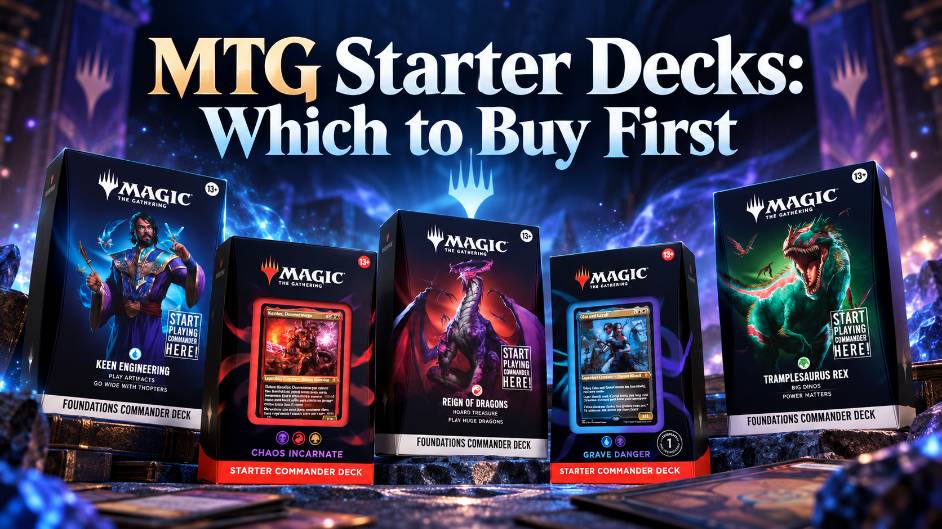
Commander Precons: Best if Your Friends Already Play
Commander is the casual four-player format most players eventually settle into. If your group already plays it, skip everything above.
A preconstructed Commander deck plays straight out of the box at around fifty dollars. You get a hundred cards, a legendary commander, and a deck that functions without any upgrades.
Still, do not start here if you do not know the rules yet. Commander adds a layer of complexity on top of normal Magic, and learning both at once is a bad first evening.
MTG Starter Decks and Products to Avoid
In practice, two traps catch new players almost universally.
Booster packs as a starting point. Boosters are for collecting and drafting, not learning. Sixty dollars of boosters gives you a pile of unplayable singles and no complete deck.
Chasing hype releases. Collector Boosters from crossover sets look exciting and are the single most expensive way to begin. They exist for collectors who already know what they are buying.
Also be wary of old starter products still sitting on shelves. Kits from pre-Foundations sets work mechanically, but their cards may no longer be Standard legal, and they lack the teaching material.
What Foundations Changed for Beginners
Wizards released Foundations in late 2024 with one stated goal: fixing the new player problem permanently.
Previous core sets rotated out of legality, so a beginner’s first cards went stale within two years. Foundations does not work that way. Its cards remain Standard legal until at least 2029, and the whole product line is built around teaching.
Consequently, the buying advice for new players is more stable now than at any point in the game’s history. That is why both entry products above are Foundations products.
What to Buy in What Order
Buy MTG starter decks in this order, and skip nothing.
- Free: MTG Arena tutorial and colour challenges. An hour, no money.
- First purchase: Foundations Beginner Box, or a two-player Starter Kit if you have a partner.
- Second purchase: Foundations Starter Collection, once you want to build rather than play pre-made decks.
- Third: a Commander precon, if your local group plays Commander. Otherwise a bundle from a current set.
- Later: singles for the specific deck you decided to build.
Notice that boosters do not appear until you have a plan. That single discipline saves most beginners a hundred dollars.
Where to Buy
Finally, local game stores usually run two to five dollars higher than online. In exchange you get people who will explain cards, weekly play nights, and somewhere to find opponents.
For a first purchase, that trade is worth it. Buy the Beginner Box locally, ask when their beginner night runs, and turn up.
Wizards publishes the full contents of each product, including the Foundations Starter Collection contents, on its own site. Our collectible and trading card games section covers how Magic compares with the newer TCGs.