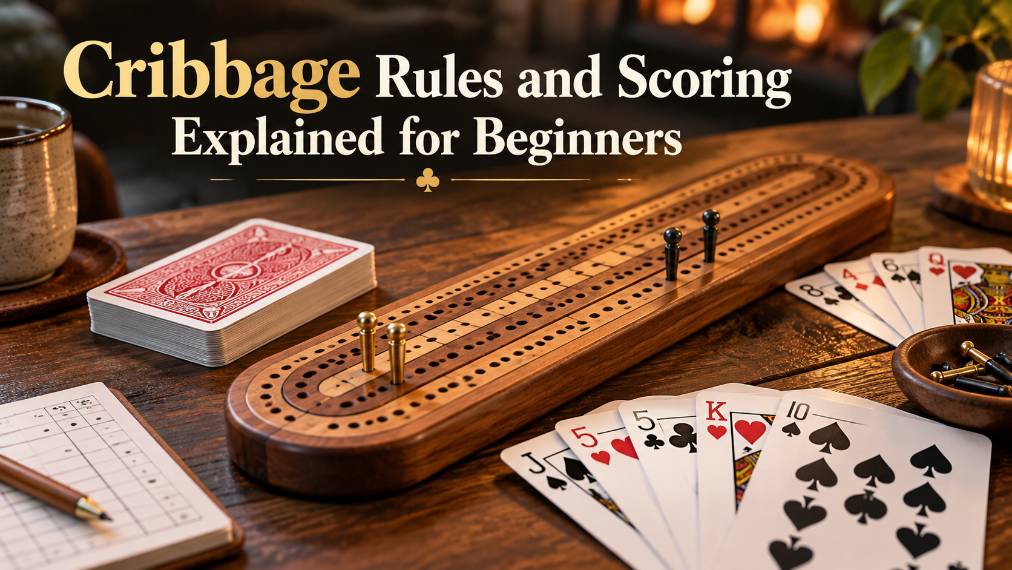
cardanoir.com – The cribbage rules ask you to do something no other card game does. You count the same cards twice, and one of the hands belongs to your opponent.
That hand is the crib. You help fill it, then watch the dealer score it. Learning when to feed it and when to starve it is most of the game.
What Cribbage Is
The cribbage rules describe a two-player game, roughly 400 years old, played with a standard 52-card deck and a wooden board with pegs.
The board is not decoration. You score constantly, in small amounts, and pegging those points by hand is genuinely faster than writing them down.
First player to 121 points wins. Some groups play a short game to 61 instead.

What You Need
- A standard 52-card deck
- A cribbage board with two pegs each
- Roughly 20 to 30 minutes
No board at hand? Paper works. Still, the board is cheap and the game is far more pleasant with one.
Of course, card values are simple. Ace counts as 1. Face cards count as 10. Everything else counts at face value.
Cribbage Rules: Dealing and the Crib
- Deal six cards to each player.
- Each player discards two face-down into the crib.
- The crib belongs to the dealer, who scores it at the end of the hand.
- Both players keep four cards for the rest of the hand.
Naturally, that discard is the first real decision in the game. As dealer, you want to throw good cards into your own crib. As the non-dealer, you want to throw rubbish.
So the classic advice: never throw a 5 into your opponent’s crib. Fives pair with every ten-value card to make fifteen, and there are sixteen of those in the deck.
Cribbage Rules: The Starter Card
After the discards, the non-dealer cuts the deck. The dealer turns the top card face-up. That is the starter.
Notably, the starter belongs to everybody. Both hands and the crib use it as a fifth card when counting.
One bonus applies immediately. If the starter is a Jack, the dealer pegs 2 points straight away. Players call it “his heels”.
Cribbage Rules: The Play
Now you alternate playing cards face-up, calling out a running total. The total may never exceed 31.
Points during this phase are pegged as they happen:
| What you do | Points |
|---|---|
| Bring the total to exactly 15 | 2 |
| Bring the total to exactly 31 | 2 |
| Play a card matching the last rank (pair) | 2 |
| Third of a kind | 6 |
| Fourth of a kind | 12 |
| Complete a run of three or more | 1 per card |
| Play the last card when nobody can go | 1 |
If you cannot play without passing 31, you say “go”. Your opponent keeps playing if they can. Whoever plays the final card takes a point.
Then the count resets to zero and you continue with any cards left.
Runs work loosely here, though, which surprises people. The cards do not need to arrive in order. Play a 4, then a 6, then a 5, and that is still a run of three.
Cribbage Rules: The Show
Once all cards are played, you count hands. Order matters enormously.
Non-dealer counts first. Then the dealer. Then the dealer counts the crib.
That order can decide the game. If the non-dealer reaches 121 while counting, they win immediately, even if the dealer’s hand and crib would have scored more.
After that, each hand uses its four cards plus the starter. Here is everything that scores:
| Combination | Points |
|---|---|
| Any cards totalling 15 | 2 per combination |
| Pair | 2 |
| Three of a kind | 6 |
| Four of a kind | 12 |
| Run of three or more | 1 per card |
| Flush — four hand cards, same suit | 4 |
| Flush including the starter | 5 |
| Nobs — Jack matching the starter’s suit | 1 |
Crucially, cards count in every combination they belong to. A single 5 might appear in three different fifteens and a pair. Count all of them.
One exception on flushes. The crib cannot score a four-card flush. It only scores if all five cards share a suit.
The Perfect 29 Hand
Under the cribbage rules, the highest possible hand is 29 points, and it is genuinely rare — roughly once in every 216,000 hands.
You need three 5s and a Jack in hand, with the fourth 5 as the starter, matching your Jack’s suit.
It breaks down like this: four fifteens using the Jack, four more using three 5s at a time, four of a kind, and nobs. That is 16 plus 12 plus 1.
Meanwhile, some totals are impossible. No cribbage hand can score 19, 25, 26, or 27. Players traditionally say “I have nineteen” to mean their hand scores nothing at all.
Counting Out Loud and Muggins
The cribbage rules require you to announce your score aloud, combination by combination. “Fifteen two, fifteen four, and a pair is six.”
Many groups also play muggins. If you miss points in your own hand, your opponent may call “muggins” and peg those points themselves.
Admittedly, it sounds harsh. In practice it is the fastest way to learn to count properly, because the penalty lands immediately.
Mistakes New Players Make
- Throwing 5s into the opponent’s crib. The single most expensive habit in the game.
- Forgetting the starter. Your hand is five cards at counting time, not four.
- Missing combinations. Every grouping counts separately, so recount before you say a number.
- Pegging carelessly. Leading a 5 hands your opponent an easy fifteen.
- Ignoring the order of counting. When you are close to 121, being the non-dealer is a real advantage.
- Keeping a pretty hand over a useful one. Four cards that make one run beat four cards that almost make two.
How to Start
Learn the cribbage rules with a printed scoring chart beside you for the first few games. Nobody memorises the combinations in one session, and pretending otherwise just slows the game.
Afterwards, focus on one habit: count your hand twice before announcing it. Fifteens first, then runs, then pairs, then flush and nobs. That order catches almost every missed point.
Finally, try the discard decision consciously. Before you throw two cards, ask whose crib it is. That single question separates beginners from competent players faster than any scoring trick.
For the complete official rules, including three- and four-player variations, Bicycle’s cribbage page is the standard reference. Our traditional and classic card games section covers the wider family, and the Euchre guide is a good next step if you want something faster with four players.