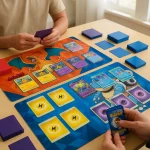
The modern Digimon Card Game (often shortened to the Digimon TCG) doesn’t try to copy the big names in trading card games. Instead, it asks a sharper question: What if every action you take literally gives your opponent the resources to hit back? That single design choice—the shared Memory Gauge—is why matches feel like a push-and-pull duel instead of two people playing solitaire side by side.
If you’re here for how to play Digimon Card Game, you’ll get the full breakdown: core zones, turn flow, battling, and deck-building. If you’re here for the bigger story—its origins, set history, and why certain releases (like Great Legend and Cyber Eden) matter—you’re in the right place too.
- Origin: Who Made the Digimon Card Game and When It Began
- What Makes the Digimon Card Game Feel Different
- Components: Cards, Colors, and the Battlefield
- Game Setup: How a Match Begins
- Core Gameplay: How to Play Digimon Card Game (Turn Structure)
- Battling and Security Checks: The Game’s Most Cinematic Mechanic
- The Memory Gauge: Shared Resource, Shared Consequences
- Digivolution: The Real Economy of the Game
- Deckbuilding Basics: Colors, Lines, and Win Conditions
- Digimon Card Game Sets: Why Releases Matter
- Digital and Online Play: Simulators, Apps, and Mobile Options
- Strategy: How to Win More Games (Without Memorizing the Whole Card Pool)
- Cultural Relevance: Why Digimon TCG Hits Different
- A TCG That Teaches Timing
Origin: Who Made the Digimon Card Game and When It Began
The current Digimon Card Game was developed and published by Bandai (Bandai Namco’s TCG division), launching first in Japan in April 2020, followed by an international rollout that brought the English version to wider release in 2021.
This is important because Digimon has had earlier card games and collectible systems across the franchise’s history—but the 2020 launch is the foundation of the game most players mean today when they say “Digimon Card Game.”
Bandai also supports the game with official rules documentation and ongoing product lines, including boosters, starter decks, and special sets.
What Makes the Digimon Card Game Feel Different
Most TCGs reward you for “doing more” every turn. Digimon rewards you for doing just enough—because every cost you pay moves the shared Memory Gauge toward your opponent, and once it crosses to their side, your turn ends. That rhythm is core to the game’s identity.
It creates a constant tension:
- Go big now, and you might hand your opponent a huge turn.
- Play small and safe, and you might fall behind on board pressure.
That’s Digimon in one sentence: momentum management.
Components: Cards, Colors, and the Battlefield
A typical Digimon deck uses these card types:
- Digimon (your main units)
- Digi-Eggs (for the Breeding area, depending on format/deck)
- Tamers (persistent support characters)
- Option cards (one-time effects)
The battlefield is defined by zones: Deck, Hand, Trash, Security Stack, Breeding Area, and Battle Area. The Security Stack is your life buffer: when you’re attacked, you lose security cards; if you take a hit at 0 security, you lose the game.
Game Setup: How a Match Begins
Official setup is clean and quick:
- Shuffle your deck and draw 5 cards for your opening hand.
- Create your Security Stack by placing 5 cards from the top of your deck face-down (top becomes the bottom of security).
- Set the Memory Gauge to 0.
- Start the first turn.
That’s it. The complexity isn’t setup—it’s how fast the game branches after the first Digivolution.
Core Gameplay: How to Play Digimon Card Game (Turn Structure)
Your turn is usually split into two big parts: Raising and Main.
Raising Phase: Breeding to Battle
In the Breeding Area, you can hatch a Digi-Egg (if your deck uses them), and Digivolve there to build a safer foundation. Digimon in the Breeding Area are generally insulated from most effects, which is one reason raising matters.
You can also move a suitable Digimon from Breeding into the Battle Area when you’re ready to pressure your opponent.
Main Phase: Play, Digivolve, Attack, Control the Memory
This is where the game becomes a resource puzzle:
- Play a Digimon by paying its play cost (moving the memory).
- Digivolve a Digimon into a stronger form, often for less memory than playing it outright.
- Play Tamers to build long-term stability.
- Use Option cards for removal, buffs, searching, or protection.
Every cost you pay moves the memory counter. If the counter crosses into your opponent’s side, your turn ends—unless effects pull memory back before you pass priority.
Battling and Security Checks: The Game’s Most Cinematic Mechanic
Combat isn’t “attack the player directly.” You attack their Security Stack first.
- When your Digimon attacks, it performs security checks—flipping the top security card.
- If that security card is a Digimon with higher DP than your attacker, your attacker can be deleted (depending on the situation).
- If the security card has a [Security] effect, it activates immediately and takes precedence in timing.
This is why Digimon’s battles feel like raids: you don’t know what defenses are hidden until you hit them.
The Memory Gauge: Shared Resource, Shared Consequences
The Memory Gauge is a shared track used to pay costs. It’s also the game’s built-in “turn timer.”
Here’s the practical meaning:
- If you start at 0 and spend 3 memory, you might still be on your side—keep playing.
- If you spend too much and push memory to your opponent’s side, you’ve handed them a bigger turn.
Surprising fact #1: In official rules Q&A, if a card costs 11+ memory and you’re at 0, you can’t pay it—because you can only push memory so far in one move without special effects.
Digivolution: The Real Economy of the Game
Digivolution is how Digimon “levels up.” You stack the new Digimon card on top of the old one, often gaining:
- stronger DP
- new effects (On Digivolve, inherited effects, etc.)
- better attack pressure and board stability
It’s also usually more memory-efficient than playing big Digimon directly—so many decks are built around evolving lines rather than raw play-cost bombs.
Surprising fact #2: Because many effects trigger on digivolving and inherited effects live in the stack, the “history” of a Digimon matters—your stack is effectively your unit’s skill tree.
Deckbuilding Basics: Colors, Lines, and Win Conditions
A healthy beginner approach:
- Pick a primary color identity (your core mechanics and options).
- Choose a Digimon line that supports a clear plan: rush, control, security pressure, or combo.
- Add Tamers that stabilize your memory and consistency.
- Balance removal and protection.
If you want the official digimon card game set list, Bandai’s site provides a card list database per release (searchable by set). That’s the cleanest way to verify card availability and learn what each booster contains.
Digimon Card Game Sets: Why Releases Matter
Digimon’s metagame shifts with each set because new mechanics, keywords, and archetype support arrive in waves.
Digimon Card Game: Great Legend Booster Box (BT-04)
Great Legend [BT-04] is a well-known early-era booster set. Bandai’s official product page lists its English release date as June 11, 2021, along with configuration details (12 cards per pack; 24 packs per box) and rarity breakdown.
Surprising fact #3: Great Legend is one of those “identity” sets—players often remember it not only for cards, but for the moment the game’s competitive ecosystem started to feel established.
Digimon Card Game Cyber Eden (BT-22)
Cyber Eden [BT-22] appears on the official product line and has an official card list entry, meaning it’s a recognized booster release with documented contents and searchable cards.
Digimon Card Game Time Stranger (BT-24)
Bandai’s official products listing shows Time Stranger [BT-24] with a release date of January 23, 2026 (and a pre-release date listed just before it).
Digimon Card Game Special Limited Set
Bandai also lists a Special Limited Set product with a release date and card type counts, positioning it as a curated product rather than a standard booster expansion.
Surprising fact #4: Special sets like this often exist to solve a real-world problem: distributing tournament promos, exclusives, or hard-to-get staples more broadly—without forcing players to chase them through limited channels.
Digital and Online Play: Simulators, Apps, and Mobile Options
Digimon Card Game App and Digimon Card Game Mobile
Bandai released an official Digimon Card Game Tutorial App with tutorial and free battle modes for learning the basics on mobile devices.
If someone asks for the “digimon card game app,” this is the official, beginner-friendly answer: it teaches core rules, flow, and fundamental mechanics.
Digimon Card Game Online: Official and Community Paths
There isn’t a single “main” official fully digital client in the same way some TCGs have—however, Bandai has run official online initiatives, including a tested webcam lobby client concept for organized online play with real cards.
Digimon Card Game Online Simulator
In the community, players commonly use webcam play (Discord-style setups), and fan tools for deckbuilding and testing. The safest practical advice is:
- Learn rules via the official tutorial app.
- Build lists using official card lists.
- Play online via webcam communities or sanctioned event structures when available.
(If you meant a specific “official online simulator,” tell me the name you’re seeing and I’ll verify it.)
A separate digital future: Digimon Alysion
Bandai has also announced Digimon Alysion, a mobile digital trading card game concept distinct from the paper TCG ecosystem (with its own features and direction).
Strategy: How to Win More Games (Without Memorizing the Whole Card Pool)
1) Treat memory like a weapon, not a bill
The best Digimon turns are “tempo turns”: you gain board advantage while leaving your opponent with awkward memory.
Ask every action:
- Does this move win me board position enough to justify giving them 3–5 memory?
- Can I sequence so I end my turn at 1 memory on their side instead of 4?
2) Pressure security with purpose
Security checks are high variance. Don’t throw attacks blindly into unknown defenses. Plan:
- Attack when you can survive security outcomes.
- Use effects that gain value on attack or when checking security.
- Time your “all-in” when you can threaten game next turn.
3) Build stacks that matter
A tall stack with inherited effects is often more valuable than three medium bodies—until you face removal. Learn your archetype’s balance between “wide” and “tall.”
4) Know when to move out of Breeding
Breeding is safety. Battle is risk and reward. Move out when:
- you can gain immediate value (attack, effect triggers),
- you can protect the stack,
- or you must race.
Cultural Relevance: Why Digimon TCG Hits Different
Digimon’s theme is transformation—growing through conflict, evolving under pressure. The card game captures that in mechanics rather than just artwork. You literally stack growth stages, inherit lessons, and fight through uncertainty (security) to reach a decisive moment.
That’s why Digimon appeals beyond pure competition: it feels like a story engine. Your deck isn’t just a list; it’s a narrative arc—rookie to mega, chaos to control, risk to payoff.
Surprising fact #5: Digimon’s signature feel comes from blending “life” and “interaction”: security is your defense, but it also becomes a trigger zone where effects can explode mid-battle.
A TCG That Teaches Timing
The Digimon Card Game is ultimately a game about timing—not just what you play, but when you pay for it, and what you hand your opponent in exchange.
The Memory Gauge makes greed expensive. The Security Stack makes certainty impossible. And Digivolution makes growth feel earned—layer by layer, decision by decision.
That’s why it lasts. Not because it’s complicated—because it’s alive. Every turn is a negotiation with the future.