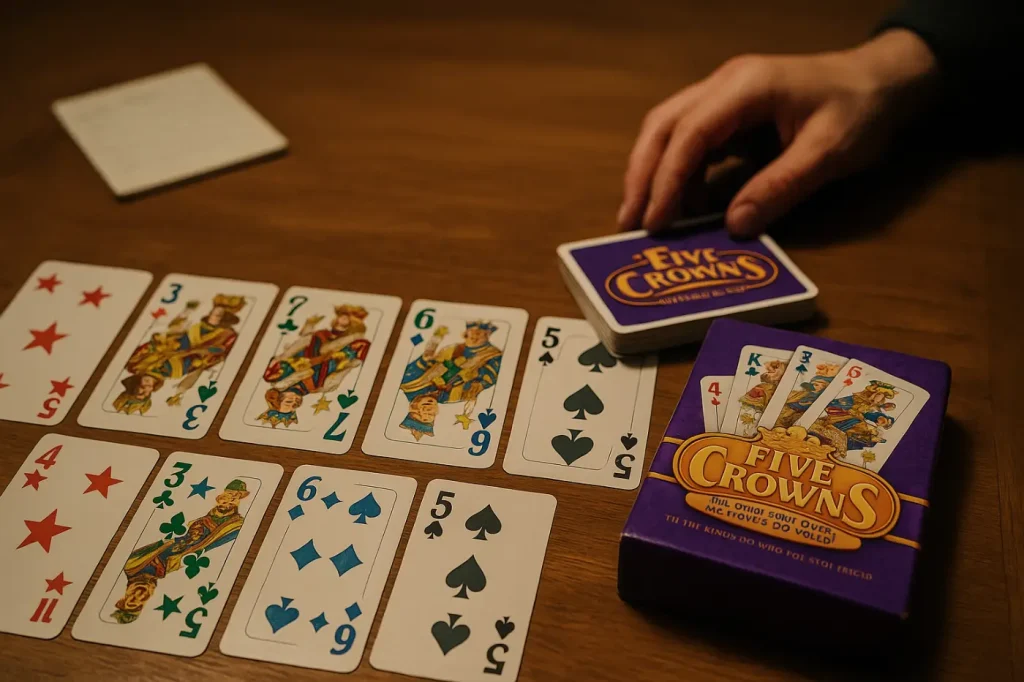
Among modern family card games, few titles carry a reputation as warm, reliable, and surprisingly deep as Five Crowns or 5 Crowns. Published in 1996 by Set Enterprises , the game entered a world already full of rummy variants—yet somehow carved out a space entirely its own. It didn’t shout for attention. Instead, it did something more lasting: it rethought the rummy formula just enough to make it feel contemporary, flexible, and endlessly replayable.
What makes Five Crowns remarkable isn’t complexity. In fact, you can explain the entire game in under a minute. But beneath that simplicity lies a clever set of design decisions: a rotating wild card mechanic, a five-suit deck, escalating hand sizes, and a scoring system that rewards calculated risk. These elements create a flowing experience—gentle in the beginning, tactical midway through, and thrilling in the final rounds, when everything tends to turn upside-down.

Five Crowns is a reminder that innovation doesn’t always come from adding layers. Sometimes, it comes from reshaping the foundation.
A Deck with Its Own Logic
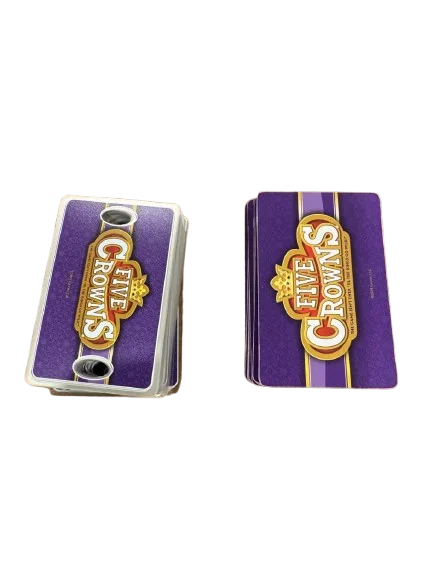
The first surprise is the deck itself. Five Crowns uses 116 cards, a combination of two 58-card decks that each include five suits—stars, hearts, clubs, spades, and diamonds—along with three Jokers per deck . Each suit contains eleven ranks, from 3 through King. There are no Aces or 2s, a design choice that tightens the probability window of early melds and speeds up first-round decisions.
This deck architecture accomplishes three things:
- Five suits open up run possibilities
Runs in a five-suit system behave differently from traditional rummy. They’re easier to form but harder to complete perfectly, creating a satisfying tension. - The removal of low ranks speeds gameplay
With 3 as the base value, melds become meaningful more quickly. - Jokers in every deck intensify unpredictability
They’re always wild, always valuable, and always capable of saving—or sabotaging—a round.
But the real star of the system is the mechanic that defines the identity of the game: rotating wild cards.
Rotating Wilds: A Brilliant Bit of Design
Each round has a specific wild card based on the number of cards dealt that round. In a 3-card round, 3s are wild. In a 4-card round, 4s are wild. And so on. When you reach the eleventh and final round—where 13 cards are dealt—Kings go wild .

This mechanic ensures:
- Every round feels distinct
- Strategies evolve continuously
- Probabilities shift in interesting ways
- No hand ever feels hopeless
The wild cards themselves are treated as 20-point penalties if left unused in your hand, raising the stakes and forcing smart decision-making .
Rotating wilds are also the origin of the game’s beloved slogan:
“The game isn’t over ’til the Kings go wild!”
Ask anyone who has played Five Crowns long enough—they’ve seen someone lose for ten rounds and suddenly win everything in the final stretch.
Five Crowns Rules : Eleven Rounds, One Rising Arc
A full game of Five Crowns consists of eleven rounds, beginning with three cards per player and increasing by one each round until the final hand with thirteen cards .
Each round follows a clean rhythm:
- Draw from the deck or the top of the discard pile
- Build books or runs (even if you don’t lay them down yet)
- Discard one card
- Go out when your hand can be fully melded
- Opponents receive one last turn to finish their books or runs
- Score remaining cards (lowest score wins overall)
A book consists of 3+ cards of the same value (any suits)
A run consists of 3+ consecutive cards of the same suit
This is all you need to start playing. And yet, the game reveals its depth slowly, like a puzzle that changes shape each time you look at it.
Scoring: Simple, Fair, and Dangerous
Five Crowns uses a scoring system that encourages ambition but punishes hesitation.
- Number cards = face value
- J = 11
- Q = 12
- K = 13
- Wild cards = 20
- Jokers = 50 (!)
Jokers are the rarest and most chaotic elements of the game. They can save your round or ruin it, depending entirely on whether you manage to meld them in time.
One of the game’s subtle insights is that players naturally take greater risks as hand sizes increase. Early rounds are fast and instinctive; late rounds are strategic and full of tension. Good players learn to shift gears.
Books and Runs: Two Simple Ideas with Endless Variations
The heart of Five Crowns lies in how you combine your cards.
Books
Three or more cards of the same value, any suit.
Wild cards or Jokers can replace any card in the set.
Runs
Three or more sequential cards of the same suit, with wilds or Jokers filling any gap.
Because of the five-suit deck, players discover far more options for runs and hybrid melds, making the game surprisingly flexible and forgiving.
But that flexibility has a cost: you must know when to commit and when to keep building. Waiting too long invites disaster.
Solo, Family, or Competitive—It Works Everywhere
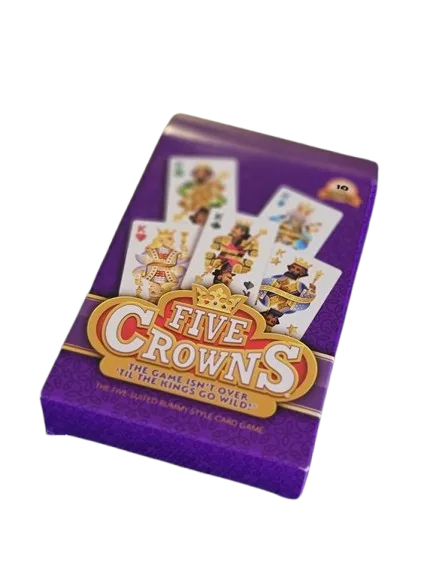
Five Crowns supports 1 to 7 players in the main game, but it also includes a solo mode called Five Crowns Solitaire, where you attempt to close out all 11 hands before the draw pile collapses .
How Many People Can Play Five Crowns?
Five Crowns is a versatile card game designed to accommodate 1 to 7 players in the main game. The game is great for both small and larger groups, making it adaptable for various settings. Whether you’re playing with friends, family, or even alone, Five Crowns offers a range of options to enjoy the experience.
Can You Play Five Crowns with One Player?
Yes, you can play Five Crowns solo. In fact, the game includes a solo mode known as Five Crowns Solitaire. In this mode, you work through all 11 hands in an attempt to close them out before the draw pile collapses. This version of the game still captures the core elements of the original, but with a focus on completing the game on your own.
Five Crowns Solitaire is perfect for practicing strategy or just relaxing with a card game when you’re alone.
How Many Players for Five Crowns?
The ideal number of players for Five Crowns is 4–5 players, as the game is best enjoyed when there’s a bit of competition and interaction. However, it’s flexible enough to work for 1-7 players.
- For two players: The game works well, though it can be slightly slower due to fewer players competing for cards. You’ll still enjoy the strategy of managing your hand and making decisions.
- For three players: The dynamic becomes more competitive, as there’s a good balance between strategy and luck. Each player has more control, and the game becomes faster-paced than with four or more players.
- For larger groups: The fun of Five Crowns increases with more people. The competition heats up, and you’ll have more interaction, making it an excellent choice for family gatherings, parties, or game nights with friends.
How Does the Number of Players Affect Gameplay?
- With One Player (Five Crowns Solitaire): The solo mode changes the dynamic entirely, as you’re not interacting with others but still experiencing the same strategic challenges. It becomes a race against time to manage the 11 hands efficiently.
- With Two Players: The game plays at a slightly slower pace since the stakes aren’t as high with fewer players. However, the strategic depth remains. You will be more likely to complete your sets without much interference, but you’ll still have to be mindful of what your opponent is doing.
- With Three Players and Beyond: The excitement increases as more players get involved. There’s more competition for cards, and the scoring phase becomes more tense, as more players are trying to make their sets and prevent you from doing the same.
Does Five Crowns Work with More Than 7 Players?
Officially, Five Crowns supports up to 7 players in its main game. While it is designed for 2 to 7 players, it may not work as seamlessly beyond this range. For larger groups, it’s recommended to use multiple decks or consider alternative variations.
It’s one of the rare card games that works seamlessly across:
- family settings
- casual gatherings
- competitive gaming groups
- libraries
- therapy / cognitive training programs
- RV communities
- travel nights
This adaptability is also why it maintains strong sales nearly three decades after its release.
It’s easy to learn, hard to master, and—most importantly—hard to stop playing.
Unique and Interesting Facts About 5 Crowns
Here are things even many long-time players don’t know:
- Five Crowns was designed by Marsha J. Falco, creator of SET and several award-winning visual-logic games.
- In serious play, people track discards to anticipate opponents’ books and runs.
- Because rotating wilds increase unpredictability, the final round has the highest comeback rate in casual play.
- If two players tie for lowest score, the official rules allow for either co-winners or a special 6-card tie-breaker round .
- With two copies of the game, you can scale Five Crowns up to 14 players without breaking core mechanics.
A Game That Thrives on Human Connection
Five Crowns doesn’t rely on fancy components, licensed characters, or trendy mechanics. What it offers instead is rhythm, clarity, and a slow build toward shared anticipation. You watch someone reach for the draw pile. You check their face. You wonder if they’re about to go out. Your strategy shifts. Your pulse picks up a little.
In a world overflowing with digital noise, Five Crowns remains one of those rare games where people look up, talk, tease, scheme, laugh, and end the night feeling a little closer than before. Its genius lies not in spectacle, but in the way it amplifies interaction.
Five Crowns is a modern card-game classic not because it tries to be clever—but because it understands how people love to play.
And yes, the game truly isn’t over ’til the Kings go wild.