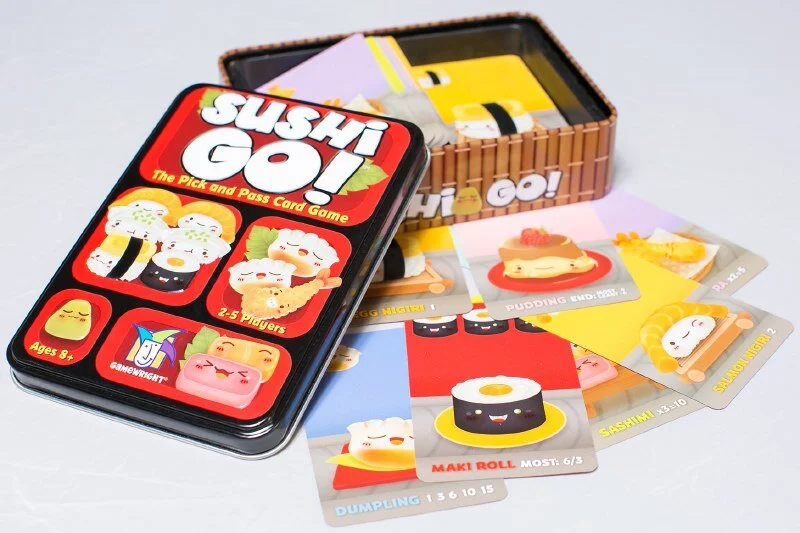
cardanoir.com – The Sushi Go rules fit on one card. Pick a card, pass the rest, repeat. A full game takes fifteen minutes.
Yet the game is a proper card-drafting engine underneath. Phil Walker-Harding designed it, and Gamewright put it in a tin small enough to live in a bag. That combination is why it shows up at so many family tables.
What Sushi Go Is
The Sushi Go rules work with two to five players around a table. Everyone holds a hand of cards. You all choose one card at the same time, reveal it, then pass what is left to the player on your left.
Then that loop repeats until the cards run out. Then you score. Three rounds later, the highest total wins.
The theme is a conveyor-belt sushi restaurant. Naturally, the cards are sushi dishes, and each one scores differently.

Sushi Go Rules: Setting Up
The deck holds 108 cards. Deal depends on how many people are playing:
| Players | Cards each |
|---|---|
| 2 | 10 |
| 3 | 9 |
| 4 | 8 |
| 5 | 7 |
First, keep your hand hidden. Then leave space in front of you, because everything you pick stays face-up there for the rest of the round.
You will play three rounds. Also, grab a pen — the scores need writing down between rounds.
Sushi Go Rules: Draft and Pass
Here is the whole turn structure.
- Everyone picks one card from their hand, face-down.
- Reveal together. Place the card face-up in front of you.
- Pass the rest of your hand to the player on your left.
- Repeat until only one card is left.
That final card gets played automatically. Sometimes it is worthless. Occasionally somebody is forced to hand you exactly what you needed.
Because every card you take is a card your neighbour cannot have, drafting cuts both ways. In practice, that is where the whole game lives.
Sushi Go Rules for Scoring Each Card
In short, this is the part of the Sushi Go rules worth printing and keeping in the tin.
| Card | Scoring |
|---|---|
| Tempura | 5 points per pair. A single scores 0 |
| Sashimi | 10 points per set of three. One or two score 0 |
| Dumpling | 1 / 3 / 6 / 10 / 15 points for 1, 2, 3, 4, or 5+ |
| Maki rolls | Most icons scores 6. Second most scores 3 |
| Egg nigiri | 1 point |
| Salmon nigiri | 2 points |
| Squid nigiri | 3 points |
| Wasabi | Nothing alone. Triples the next nigiri you play |
| Chopsticks | Nothing. Lets you take two cards later |
| Pudding | Scored at the very end only |
Of course, dumplings are the card people misread most. Five dumplings are not five times better than one. They are fifteen times better.
Maki rolls work differently again, though. The cards show one, two, or three icons. Add up your icons, then compare with everyone else. Ties split the points and round down, and if several players tie for most, nobody gets the second-place three.
Wasabi and Chopsticks
Two cards break the normal pattern in the Sushi Go rules. Besides that, both reward planning.
Wasabi sits empty until you play a nigiri on top of it. Then that nigiri triples. Squid nigiri on wasabi is nine points, which is the biggest single card score in the game. However, a wasabi with nothing on it scores zero, so play it early enough to use it.
Chopsticks let you take two cards instead of one on a later turn. When you do, you shout “Sushi Go!” and put the chopsticks back into your hand. So they pass to the next player, who can use them again.
Chopsticks are best when you need the second half of a pair. Still, they cost you a card now for a card later, so timing matters.
Pudding Decides More Games Than You Think
Under the Sushi Go rules, pudding does nothing in rounds one and two. You set it aside instead. Then at the very end of the game, it scores.
Most puddings: +6 points. Fewest puddings: −6 points. That is a twelve-point swing, and it is bigger than almost anything else in the game.
One exception worth remembering. In a two-player game, nobody loses six for having fewest.
New players ignore pudding for two rounds and then lose by four points. Do not be that player.
Sushi Go Rules for Ending a Round
Once the last card is played, score everyone’s face-up cards. Write the totals down.
Then discard everything except pudding. Puddings stay in front of you all game. After that, deal fresh hands and start the next round.
Finally, after round three, score the sushi as normal and add the pudding result.
Strategy That Actually Works
Once the Sushi Go rules are clear, these habits win rounds.
- Count what you pass. If you hand your left-hand neighbour a third sashimi, you just gave them ten points.
- Do not chase sashimi late. One or two sashimi score nothing at all. Abandon the set if the third is not coming.
- Dumplings are safe. Nobody can zero you out, and the curve pays off fast.
- Take maki only to win it. Second place is three points. Third place is nothing.
- Watch the hand sizes. As hands shrink, you can see exactly what is left and who will get it.
- Play wasabi early. Late wasabi is a dead card.
- Grab pudding in round two. By round three everyone is fighting for it.
Sushi Go Party and Other Versions
Meanwhile, Sushi Go Party! is the bigger box. It plays up to eight, adds a scoring board, and lets you build a custom menu from twenty-odd card types each game. If your group plays often, this is the better buy.
Sushi Roll is the dice version. Same scoring ideas, different medium.
Still, the original tin is the best travel option. It costs very little, fits in a pocket, and teaches the drafting mechanic that games like 7 Wonders use at a much larger scale.
Why It Works With Kids
Everyone plays at once. Therefore nobody waits, and nobody gets bored between turns.
In fact, the maths is small enough for an eight-year-old to do unaided. Adding icons and counting pairs is the hardest part.
Above all, losing takes fifteen minutes rather than an hour. That matters more with children than any rule in the box.
For the complete rules text, Board Game Arena’s Sushi Go help page mirrors the official rulebook. Our family and party card games section covers more games for mixed ages, and the Codenames guide is the natural companion for larger groups.