cardanoir.com – The Codenames rules take two minutes to explain. Two teams, twenty-five word cards, and one person on each side who knows the answers. Everything hard about the game happens in your head.
First, some background. Vlaada Chvátil designed it. Czech Games Edition published it in 2015. It won the Spiel des Jahres a year later, and it has been the default “what do we play with nine people” answer ever since.
What Codenames Is
The Codenames rules start with twenty-five word cards face-up in a grid. Some belong to the red team. Some belong to blue. Some belong to nobody. One is the assassin.
Only the two spymasters know which is which. Then they take turns giving their team one-word clues. After that, their teammates guess. The first team to find all its own words wins.
Notably, there is no board, no dice, and no timer unless you want one. It is a pure card game that happens to come in a box.

Codenames Rules: Setting Up the Grid
- Split into two teams. Red and blue. They do not need to be even.
- Pick one spymaster per team. They sit together on one side of the table.
- Lay out 25 word cards in a 5×5 grid.
- Slide a key card into the stand between the spymasters. Nobody else may see it.
- Check the lights. The four coloured edges of the key card show which team starts.
The starting team has nine words to find. The other team has eight. Seven cards are innocent bystanders. One is the assassin.
So that nine-versus-eight split is the only handicap in the Codenames rules. It matters. Going first is an advantage, so the starting team simply has more work to do.
Codenames Rules: Giving a Clue
In the Codenames rules, a clue is exactly two things: one word and one number.
The word points at your team’s cards. The number says how many cards it points at. Say “ocean, 3” and your team knows three of their words relate to the ocean.
Of course, the restrictions are short:
- The clue must be a single word.
- It cannot be a word visible on the board.
- It cannot contain, or be contained in, a visible word.
- It must be about meaning, not spelling, position, or rhyme.
So you cannot say “it rhymes with fish”. You also cannot say “the card in the top left”. Those are the two rules new players break constantly.
Meanwhile, spymasters must keep a straight face while their team debates. No hints, no eyebrows, no sighing.
Guessing and the Plus-One Rule
Your team discusses out loud. Then someone touches a card. In fact, that is the only formal action in the Codenames rules. That touch is the official guess.
- Touch your own team’s word. The spymaster covers it with your agent card. You may guess again.
- Touch a bystander. Then the turn ends.
- Touch the other team’s word. Turn over, and you just helped them.
- Touch the assassin. You lose the game immediately.
Still, you must guess at least once per turn. You may guess up to the clue number plus one.
Naturally, that extra guess exists for a reason. It lets you chase a word from an earlier clue that your team never got to. Good teams use it constantly. However, new teams forget it exists.
The Assassin Changes Everything
One black card ends the game on the spot. Because of that, the assassin shapes every clue. That single rule shapes every clue a spymaster gives.
Before you say your clue out loud, check it against the assassin. So if there is any path from your word to that card, pick a different word. A safe “2” beats a clever “4” that kills your team.
Similarly, guessers should think the same way. If a word feels only loosely connected, stop and bank what you have. Ending your turn is always legal.
Codenames Rules for Zero and Unlimited
Two special numbers exist in the Codenames rules. Most groups never use them.
Zero. Say “fruit, 0” and you are telling your team that none of their words relate to fruit. Therefore it is a warning, not a target. Your team may guess as many times as they like, and they must still guess at least once.
Unlimited. Say a word plus “unlimited” instead of a number. Your team may keep guessing without limit. This is for late-game moments when several older clues are still hanging unresolved.
Both carry real risk, because your team must still make one guess. Use them once the board is nearly clear.
What Makes a Good Clue
In practice, three to four words is the sweet spot. Although one or two is safe, it is slow. Five or more is usually a trap.
A few habits separate strong spymasters from the rest:
- Aim for the obvious link, not the clever one. Your team cannot read your mind.
- Say the number with confidence. Hesitation tells them you are unsure, and they overthink it.
- Track what they missed. Unfound words from earlier clues are free guesses later.
- Avoid words with many meanings. They spray in every direction, including toward the assassin.
- Watch the opponent’s board too. A clue that also fits their words costs you the turn.
Finally, guessers have one job in return: work out why that word was chosen. Because the clue compresses the spymaster’s reasoning, it repays unpacking. Unpack it out loud.
Playing With Big Groups
This is where the Codenames rules beat almost everything else. There is no limit on team size. Twelve people works. Meanwhile twenty works too, if noisily.
Extra players cost nothing, since only the spymaster acts alone. Everybody else just talks. So nobody waits for a turn, and nobody sits out.
Besides that, two practical tips help with large groups. First, pick spymasters who can stay quiet under pressure. Second, agree that one person per team does the touching, or you will get three hands on three different cards at once.
The Other Versions
- Codenames Duet — a cooperative version for two players, with its own key card system. The best one for couples.
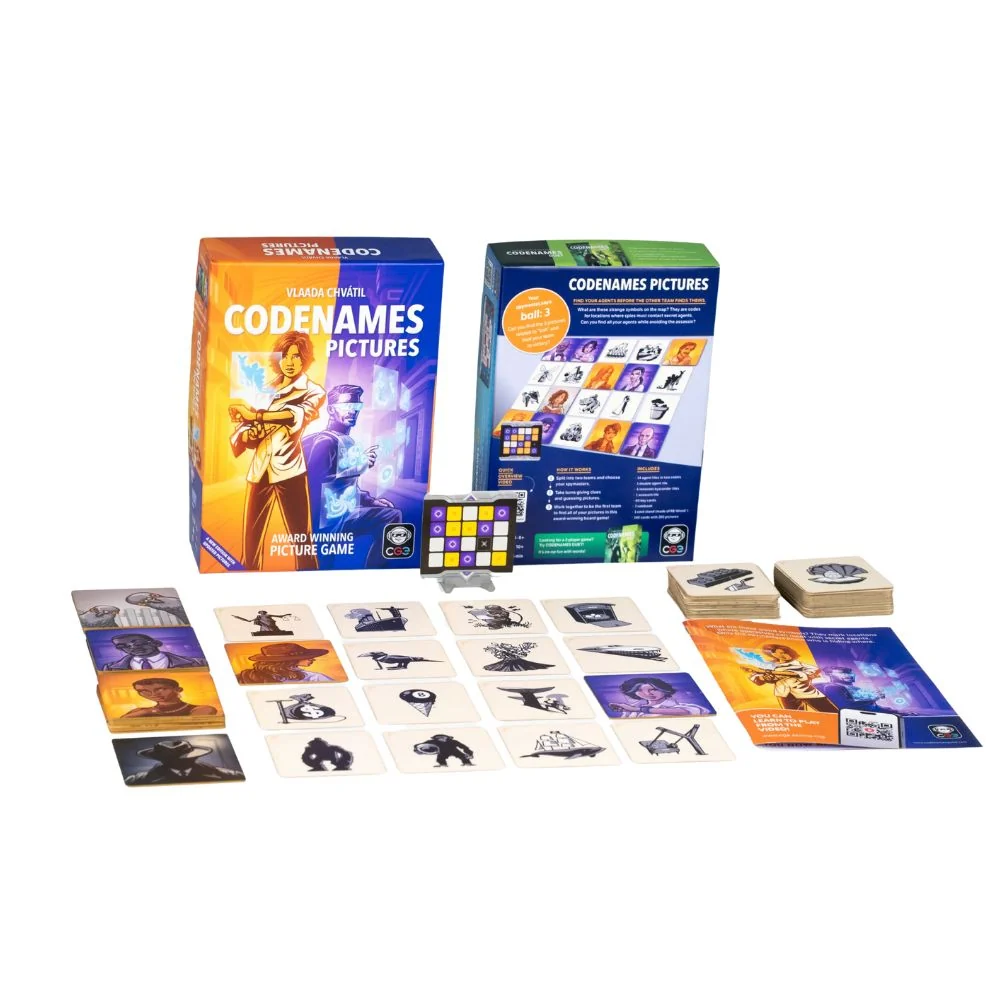
- Codenames Pictures — the same game with surreal images instead of words. Easier for mixed-language groups and younger players.
- Codenames: Deep Undercover — the adult edition. Same rules, different vocabulary.
- Themed editions — Disney, Marvel, Harry Potter, and others. Mechanically identical, so buy whichever theme your group likes.
- Codenames XXL — oversized cards for large tables.
Although the reskins are fun, the base game is still the right first purchase. Everything else is a reskin or a two-player variant.
House Rules Worth Settling First
Groups argue about the same few points in the Codenames rules. So sort them out before you deal.
Are compound words one word or two? Are proper nouns allowed? Can the spymaster use a foreign word? Does a clue about spelling ever count?
Officially, the answer to the last one is no. The others are up to you. Just decide before someone says “Batman, 2” and the table stops for five minutes.
For the full rules text and the game’s history, the Codenames entry on Wikipedia covers both. Our family and party card games section has more games for large groups, and the Cards Against Humanity guide covers the other end of the party spectrum — same group size, very different evening.