Cardanoir.com – Indonesia is one of Southeast Asia’s most dynamic consumer markets, with a population of over 270 million people, a young median age, and deeply rooted traditions of communal gathering. Within this landscape, family friendly party card games represent a compelling niche — not yet crowded, culturally resonant, and riding a broader global wave of renewed interest in physical, social tabletop entertainment. This article analyzes market trends, consumer preferences, and marketing strategies relevant to developers looking to enter or grow within this space.
Market Trends
The urban middle class is the primary growth engine. Cities like Jakarta, Surabaya, Bandung, and Medan have seen a steady rise in board game cafés, which serve as both discovery venues and community hubs. These spaces introduce new games to consumers who would not have encountered them in a conventional retail setting, and word-of-mouth from café experiences frequently drives subsequent personal purchases.
Consumer Preferences
Indonesian consumers approach family card games through a distinct cultural lens. Several patterns stand out:
Affordability is non-negotiable for most households. A game priced above IDR 150,000–200,000 (roughly $10–13 USD) faces significant resistance outside the urban upper-middle segment. Games that offer a compact, low-cost entry point with optional expansion packs perform well because they lower the initial barrier while creating long-term revenue potential.
Ease of play matters more than depth. Unlike enthusiast-driven markets in Europe or North America where complex mechanics are celebrated, Indonesian family buyers prioritize games that anyone — from a 7-year-old to a 60-year-old grandmother — can understand within five minutes. Short rulebooks, visual clarity on the cards themselves, and minimal setup time are decisive factors.
Cultural familiarity is a powerful accelerator. Games that incorporate Indonesian folklore, wayang characters, regional food, Batik patterns, or popular local references immediately carry a sense of pride and relatability that imported titles cannot match. This is the single greatest competitive advantage available to local developers.
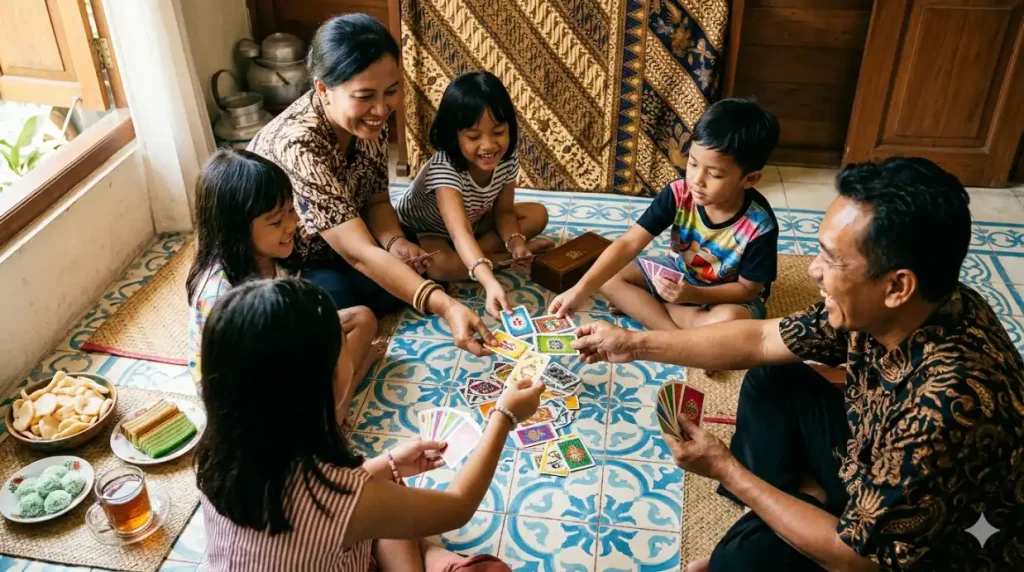
Multi-generational play is both a desire and a practical necessity. In Indonesian households, extended family gatherings during Lebaran, Natal, and other celebrations routinely bring together grandparents, parents, teenagers, and young children under one roof. A card game that genuinely works across this age range is not just a nice feature — it is a core product requirement for the family occasion market.
Marketing Strategies
Reaching Indonesian families with party card games requires a strategy that blends digital reach with community trust.
Marketplace-first distribution is essential. Tokopedia, Shopee, and Lazada dominate how Indonesian consumers discover and buy physical goods. A well-optimized product listing with clear photos, a short demo video, and competitive pricing will outperform most other channels for pure volume. Live-selling sessions on TikTok Shop and Shopee Live have also proven exceptionally effective for games because they allow sellers to demonstrate gameplay in real time, removing the uncertainty that comes with buying an unfamiliar product.
Community seeding before paid advertising generates more durable traction. Sending free copies to board game café owners, family lifestyle influencers (especially those focused on parenting), and YouTube content creators in the “family activities” space builds organic credibility. Indonesian consumers are highly influenced by social proof, and a genuine enthusiastic review from a trusted figure carries far more weight than a banner ad.
Seasonal campaign timing is critical. The two weeks before Lebaran and the December holiday period are when Indonesian families make the majority of their discretionary gift and entertainment purchases. Marketing budgets concentrated in these windows — with gift-appropriate packaging, bundle deals, and family messaging — will yield significantly higher returns than evenly distributed spend.
Local language and imagery in all marketing content is not optional. Packaging, social media posts, and even instruction booklets should be in Indonesian, not English. Content that shows recognizable Indonesian family settings — a tiled living room floor, sarong-clad grandparents, familiar food on the table — resonates far more than generic lifestyle photography.
Recommendations for Developers
Based on this analysis, the following strategic recommendations apply to anyone developing family friendly party card games for the Indonesian market:
Design for the 7-to-70 range from day one. Playtest every mechanic with a real multi-generational group, not just peers. If an elderly relative cannot follow the rules after one read-through, simplify.
Price at the mass-market tier on entry. Launch at IDR 100,000–150,000 and build revenue through bundles, expansions, or limited edition versions rather than by starting high and discounting.
Embed Indonesian culture authentically, not decoratively. Superficial local theming (just putting a wayang skin over a Western mechanic) is immediately recognizable and underwhelming. The most successful local games will be ones where culture is woven into the game’s core concept and humor.
Build a café partnership network early. Approach board game cafés with free copies and promotional materials. A game that lives in twenty cafés across Java will sell more copies than one that only exists on a marketplace listing.
Use short-form video as the primary marketing medium. A 30-second TikTok or Instagram Reel showing a real family laughing around a card game is the single most effective piece of marketing content available. Prioritize this over print, display advertising, or long-form content.
Plan for educational positioning. Parents are more willing to spend on games framed as developmental tools. If the game strengthens vocabulary, quick thinking, or social skills, make that explicit on the box and in all marketing copy.
Conclusion
The family friendly party card game niche in Indonesia is genuinely underserved relative to the size of the opportunity. The cultural conditions — strong family bonds, frequent communal gatherings, growing urban middle class, and rising interest in screen-free entertainment — are precisely the ingredients that make this category thrive. The developers best positioned to succeed are those who resist the temptation to simply localize foreign titles and instead build games that feel unmistakably Indonesian from the inside out. The market is ready; it is waiting for the right products to meet it.