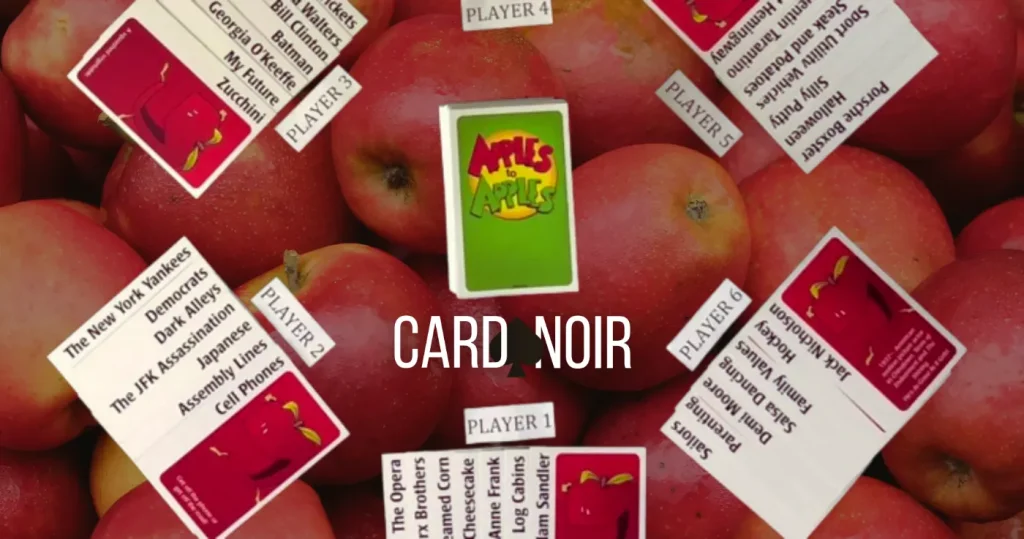
There’s a special kind of laughter that only happens when someone confidently argues that “A Bad Haircut” is the best match for “Magnificent.” That’s the secret engine of the Apples to Apples card game: it turns ordinary words into a room full of opinions, inside jokes, and surprisingly passionate debate.
At its core, Apples to Apples is simple—match a red “thing” to a green “description.” But the real game lives in the people at the table: how they think, what they find funny, and how well they can read a judge’s taste in that exact moment.
This guide covers the Apples to Apples rules, how to play Apples to Apples, player count, components, strategy, variations (including Apples to Apples Junior), and how the game evolved into a modern party staple.
What Is Apples to Apples?
Apples to Apples is a party card game where players create comparisons by pairing two different types of cards:
- Green Apple cards: adjectives or descriptions (like “Beautiful,” “Weird,” “Dangerous”).
- Red Apple cards: nouns—people, places, things, events (like “New Orleans,” “Lightning,” “Paying Taxes”).
Each round, one player is the judge. Everyone else plays one red card face-down that they think best matches the green card. The judge reveals the red cards and picks the winning match. If the judge picks your card, you win the green card as a point.
Quick Facts Players Always Ask
Apples to Apples: How many players?
Officially, Apples to Apples is for 4–10 players.
How many cards are in Apples to Apples?
A commonly referenced “deluxe” style set lists:
- 749 Red Apple cards
- 249 Green Apple cards
- plus a few blank write-in cards (for custom jokes)
Can you play Apples to Apples with 2 players?
Not officially—Apples to Apples is designed around a judge + multiple players. But people do house-rule it for 2–3 players (I’ll show solid options later), especially if you want a quick laugh without a crowd. The official rules support 4–10.
Who Invented Apples to Apples?
The game is credited to Matthew “Matt” Kirby, and it was published by Out of the Box Publishing in 1999.
In a later era of its popularity, Mattel acquired rights to manufacture, distribute, and market Apples to Apples (along with other Out of the Box titles) in 2007.
This timeline matters because it explains why there are so many versions today: original editions, party boxes, themed sets, kids editions, and more—each designed to keep the core idea fresh while changing the cultural vocabulary on the cards.
What’s in the Box? (Cards, Trays, and the Two-Deck System)
Most editions follow the same structure:
- A stack of Green Apple description cards
- A larger stack of Red Apple “thing” cards
- Card trays (in many boxed versions)
- Sometimes blank cards to personalize the deck
That two-deck system is the design genius: the green card sets the “lens,” the red card supplies the “subject,” and humans supply the argument.
Apples to Apples Rules: Setup (The Clean, Correct Version)
Here’s the standard setup used in Mattel’s rules:
- Choose a first judge.
- The judge deals seven red cards to each player (including the judge).
- Place the green deck face-down (or in a tray). Place the red deck in reach.
That’s it. You can teach the game in under a minute—and that’s part of why it became a go-to party game.
How to Play Apples to Apples (Step-by-Step)
Each round follows the same rhythm:
1) Judge reveals a Green Apple card
The judge draws a green card, reads it aloud, and places it face-up.
2) Everyone else chooses a Red Apple card
All non-judge players select one red card from their hand that they think best matches the green description.
They play it face-down so the judge can’t see who played what.
3) Judge shuffles, reveals, and chooses a winner
The judge mixes the face-down red cards, flips them one by one, reads them aloud, and chooses the one they feel is the best match—whether funniest, most accurate, or simply the most “judge-brain” answer that round.
4) Winner takes the Green card
Whoever played the winning red card keeps the green card as a point.
5) Rotate the judge
The role of judge passes to the player on the left, and hands are refilled to seven red cards.
Winning the Game: How Many Green Cards Do You Need?
This is one of the most searched questions because it changes by player count.
According to Mattel’s rules, the number of Green Apple cards needed to win is:
- 4 players: 8
- 5 players: 7
- 6 players: 6
- 7 players: 5
- 8–10 players: 4
Why the scaling? Because more players means more rounds happen faster, so the win condition drops to keep the game from dragging.
“Quick Pick” Option: The Simple Way to Stop Slow Turns
With five or more players, there’s an official speed-up rule sometimes called the Quick Pick Option: the last red card played to the table doesn’t get judged and returns to the player’s hand. Translation: play quickly or your card doesn’t count.
It’s a small tweak, but it changes the energy from “let me think…” to “move—this is a party.”
How Many People Can Play Apples to Apples Comfortably?
Officially: 4–10. Practically:
- 4–6 players: best balance of speed + judge variety.
- 7–10 players: louder, faster, more chaotic, and often funnier—especially with Quick Pick.
- 2–3 players: not ideal by design, but possible with house rules.
House-rule options for 2–3 players (that actually work)
If you must play with fewer people, here are two clean approaches:
Option A: Rotating Judge + “Ghost Hand”
- Deal a third hand (“ghost”).
- When choosing, each real player plays a red card, and the ghost hand contributes one random red card.
- Judge chooses among 2–3 options each round.
Option B: No Judge, Vote Instead
- Reveal the green card.
- Both players submit a red card.
- Then both players vote secretly (or alternate “chooser” role).
- This keeps the core tension alive without needing a crowd.
These aren’t official rules, but they preserve the spirit: subjective comparison and surprise.
Strategy: How to Win Apples to Apples Without Being the “Tryhard”
Apples to Apples is funny first, but it’s still a game. If you want more wins without killing the vibe, use judge psychology.
1) Play the judge, not the green card
The green card is the prompt. The judge is the algorithm.
Some judges pick:
- literal matches (most accurate)
- comedic matches (wildest)
- clever matches (unexpected but defensible)
You learn this by watching the first few rounds.
2) Build a “toolbox hand”
When you refill to seven red cards, don’t treat your hand as random. Keep:
- one “safe” general card (works with many adjectives)
- one “absurd” card (saves you on weird prompts)
- one “cultural” card (wins if your group loves references)
3) Win the room, not just the round
Sometimes the best match is the one that makes everyone react. Laughter can sway judges even when they pretend it doesn’t.
Variations and Editions: Apples to Apples Junior, Themed Sets, and More
One reason Apples to Apples stayed relevant is how easily it adapts to different audiences.
Apples to Apples Junior
A kid-friendly version that simplifies references and leans into school-age vocabulary. It’s commonly recommended when the standard deck feels too “adult culture” heavy for younger players.
Themed editions
There have been many themed versions over the years—designed to match specific fandoms, age groups, or cultural niches—while keeping the same judge-and-match core.
Sour Apples to Apples (spin-off)
A related spin-off exists with its own rules and components (including a spinner), but it still builds on the same comparison idea.
Apples to Apples Online: Can You Play Digitally?
Yes—Apples to Apples has had digital and online presence across different eras, and it’s widely available through modern retail channels under Mattel’s umbrella.
Digital versions tend to solve one thing beautifully: you can play with friends remotely, and the game handles shuffling, dealing, and anonymity automatically. The trade-off is you lose the room energy—the arguing, the timing, the eye contact. Apples to Apples is a social game first.
Cultural Impact: Why This Game Worked (and Still Does)
Apples to Apples became a staple because it hits three rare targets at once:
- Instant teach (seven cards, pick one)
- Low risk (no trivia pressure, no “wrong” answers)
- High personality (your choices reveal how you think)
It’s also been recognized in the hobby space over time, including induction into the Origins Award Hall of Fame (as noted in coverage and reference summaries).
And it helped popularize an entire sub-genre: judge-based party games built on subjective matching.
5 Surprising Facts About Apples to Apples
- The win condition changes by group size—from 8 green cards (4 players) down to 4 (8–10 players).
- Many boxed versions list hundreds of cards, including 749 red and 249 green in one ruleset.
- There’s an official pace booster: Quick Pick, which punishes the slowest play in larger groups.
- The game’s modern publishing history includes a major shift when Mattel acquired rights in 2007.
- Apples to Apples has inspired countless themed editions and related comparison-style party games—proof that one simple mechanic can turn into a whole culture.
The Real Point of Apples to Apples
On paper, Apples to Apples is about matching cards. In practice, it’s about learning how other people think—what they find clever, what they find ridiculous, what they’ll defend with a straight face.
It’s a game that rewards creativity without punishing anyone for not being “good at games.” And that’s why it works at family tables, dorm rooms, and crowded living rooms: the cards are just prompts. The real content is the people.