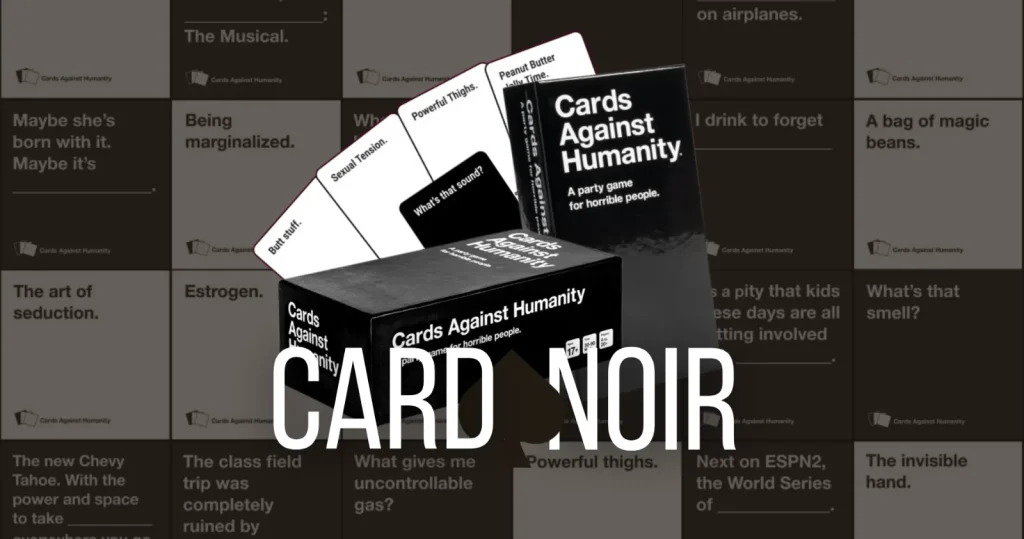
Cards Against Humanity (CAH) is one of the rare modern card games that didn’t just reach mainstream popularity — it redefined what an adult party game could be. Irreverent, intentionally offensive, and powered by user-generated humor, it became a global sensation within just a few years of launch.
But behind the black-and-white cards and chaotic combinations lies a surprisingly rich origin story, a Kickstarter triumph, and a wave of cultural impact that continues today. This article explores the game’s creation, evolution, critical reception, and why it remains such a staple at parties.
What Is Cards Against Humanity?
Cards Against Humanity is an adult party game in which players complete fill-in-the-blank phrases using prewritten cards containing words or statements — often politically incorrect, crude, or shockingly absurd. The structure is simple: one black card sets up a prompt, and players compete to choose the funniest (or most outrageous) white card response.
The creators themselves billed it as “a party game for horrible people,” and its combination of dark humor, social satire, and absurdity is exactly why it became a cult hit.
How Cards Against Humanity Was Created
Cards Against Humanity began as a homegrown idea among eight friends — alumni of Highland Park High School near Chicago. Their early prototype, originally named Cardenfreude (a pun on Schadenfreude), was loosely inspired by Apples to Apples, along with influences from Magic: The Gathering, Balderdash, Charades, and Mad Libs — which co-creator Ben Hantoot called the game’s “most direct inspiration.”
Kickstarter Success Story
CAH officially launched through Kickstarter in 2011. Their goal was modest — $4,000 — but the campaign exploded in popularity, ultimately raising over $15,000, more than 400% of the target. The extra funding allowed the team to add 50 more cards to the deck before release.
By May 2011, the final version dropped — and within a month, it hit #1 on Amazon’s Toys & Games category, a position it held for an extended period.
Why It Became a Global Phenomenon
Cards Against Humanity didn’t dominate because of complex mechanics or strategic depth. Instead, it became a cultural mirror — a game that rewarded quick wit, shared humor, and social chemistry.
Here’s how it achieved such lasting appeal:
1. Humor Without Restrictions
The game’s “anything goes” comedic style was a stark contrast to traditional board games. It pushed boundaries deliberately, creating viral word-of-mouth buzz.
2. Free, Open, and Modifiable
The base game was even released under a CC-BY-NC-SA license, downloadable for free as a PDF — a radical move that built goodwill and global adoption.
3. Infinite Replay Value
With hundreds of black and white cards, plus expansions, CAH sessions rarely feel repetitive.
4. Cultural Timing
Its launch coincided with rising meme culture, online communities, and a growing appetite for edgy social games.
Gameplay Overview
A typical round works like this:
- Each player draws ten white “answer” cards.
- One player — the Card Czar — draws a black “prompt” card.
- All players submit their funniest matching white card face down.
- The Czar reads them aloud and selects a winner.
- The chosen player receives an “Awesome Point.”
The rules don’t define a formal endgame — CAH prioritizes laughter over competition.
The game also encourages house rules, from democratic voting to gambling points for more card plays.
Expansions, Editions, and Growth
Over time, Cards Against Humanity expanded far beyond its original deck:
Major Expansions
- Red Box, Blue Box, Green Box, Absurd Box, Everything Box
- Dozens of thematic mini-packs
Family Edition (2020)
A kid-friendly version with 600 new cards developed in consultation with child psychologists.
Unique Promotions
CAH became famous for bizarre Black Friday stunts, including:
- Selling bull feces in 2014
- Digging a “Holiday Hole” live on stream
- Selling $6 boxes of literal nothing
- Launching fake Pringles (“Prongles”)
These stunts made the brand iconic far beyond gaming circles.
Critical Reception: Praise and Controversy
Praise from Media
Reviewers have called CAH:
- “Simple, yet well-executed” — Chicago Tribune
- “The game your party deserves” — Thrillist
Its humor and social nature earned it a reputation as the perfect adult party game.
Concerns and Criticism
Much of CAH’s controversy stems from its intentionally offensive content. Critics highlight:
- Racial stereotypes
- Sexist, violent, or traumatic references
- Punchlines involving real-world tragedies
Academic analyses have even examined racial and cultural biases embedded within card distributions.
Workplace Controversy
In 2020, co-founder Max Temkin stepped down after allegations of fostering a toxic work culture.
Despite this, the company continued operating and releasing new products.
Why Cards Against Humanity Still Endures
Even after more than a decade, CAH remains widely played because:
1. It adapts to culture.
New card packs reference politics, memes, celebrities, and trending events.
2. It’s endlessly remixable.
Fans create custom decks, house rules, and themed editions.
3. It prioritizes human connection.
Its gameplay thrives on conversation, timing, and shared laughter — things digital entertainment can’t fully replace.
4. It embraces absurdity.
In a world that increasingly feels chaotic, CAH’s humor is cathartic, giving players a space to laugh at the taboo and uncomfortable.
Cards Against Humanity isn’t just a card game — it’s a cultural artifact reflecting humor, internet culture, and social irreverence from the 2010s onward. Born from a group of friends, empowered by Kickstarter, and fueled by viral word-of-mouth, it continues to spark laughter, arguments, and unforgettable game nights.
Whether you see it as satire, social commentary, harmless fun, or an engine of offensive chaos, one thing is certain:
Cards Against Humanity changed what a party game could be — and few games have matched its impact since.